- Director's Message
- About The Director
- Heritage
- Founding Fathers
- Brand XLRI
- Vision and Mission
- Board of Governors
- Leadership and Administration
- Industry Advisory Council
- Programs and Equivalence
- XLRI’s Position & Ranking
- Accreditation
- Social Initiatives
- Rural Immersion
- Social Engagement Activities
- Mandatory Disclosure
- Careers Opportunities
- Internal Committee
- Student Profile
- Batch Profile
- Our Recruiters
- Create Visibility for your Firm
- Placement Overview
- Career Transformation Series
- Placement Office Team - PGDM(GM)
- PGDM (GM) Student Committee
- Alumni Speak - PGDM (GM)
- Virtual Internship
- Professional Mentorship Programme
- Guest Lecture Series
- CXO Series
- XL Forum Series
- PGDM (GM) Annual Alumni Meet - Confluence
- Conclaves, Seminars & Panel Discussion
- FAQs
- Fr Arrupe Centre for Ecology and Sustainability
- Financial Market Centre
- Centre for Human Resource Development
- Centre for Logistics & SCM
- Centre for Peace and Justice
- XLRI JRD Tata Foundation in Business Ethics
- Centre for Gender Equality and Inclusive Leadership
- Center for Public Policy and Public Affairs
- XLRI Centre for Spirituality & Human Development
- Case Research & Simulation Development Centre
- Fr McGrath Skill Development Centre
- Centre for Entrepreneurship
- Centre for Learning and Teaching Innovations
- Centre of AI Research and Application (CARA)
- XCITE
- Centre for Experiential and Gamified Experiences (EDGE)
- Centre for Global South Studies
- Centre for Excellence in Coaching & Leadership (X-CEL)
- XCEED - XLRI Incubator
XLRI Hosts Panel Discussion On Sri Lankan Crisis
XLRI PGDM (GM) batch has successfully conducted the Panel Discussion on Sri Lankan Crisis- Lessons for India on 6th May 2022
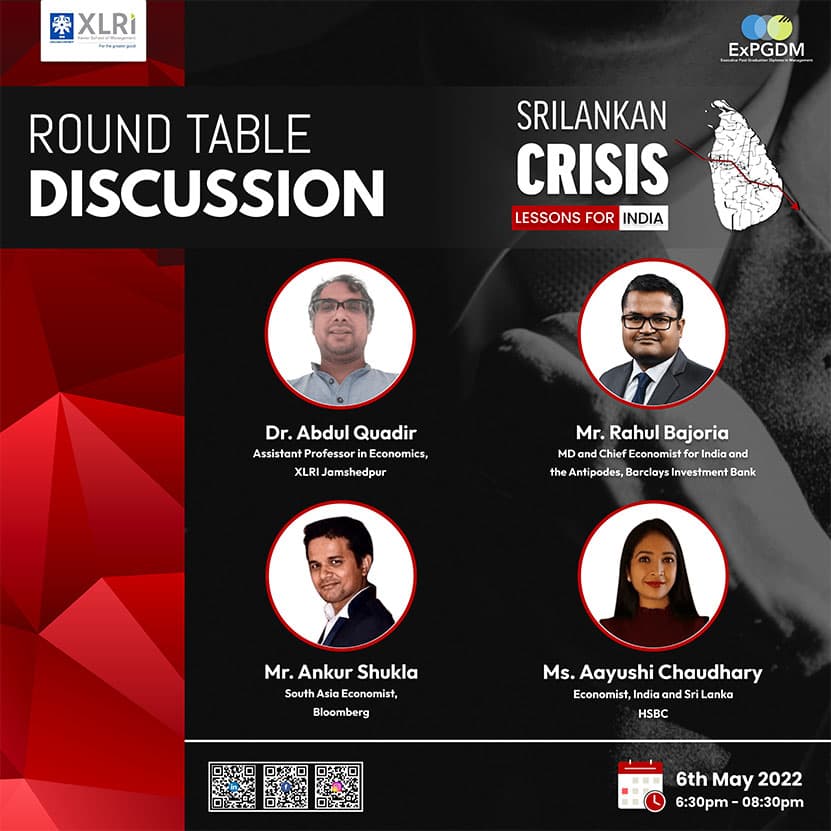
The event started with an Inaugural Address by Academics Professor Abdul Quadir, XLRI Jamshedpur , welcoming the panel members and providing the flow of the event going forward.
The esteemed panel members consisted of Rahul Bajoria, MD and Chief Economist for India and the Antipodes, Barclays Corporate & Investment Bank, Ankur Shukla, South Asia Economist, Bloomberg LP, and Aayushi Chaudhary, India and Sri Lanka Economist, HSBC.
The first speaker was Aayushi Chaudhary, who started by explaining the economic structure of Sri Lanka and the drivers that majorly impact the Sri Lankan economy. She then explains the current problem and how deep it is by giving facts and figures to corroborate it. How covid make the economy more disastrous since tourism is one of the important factors in generating an economy. She discussed the impact of banning fertilizers to encourage organic farming, which led to low production of grains and a shortage of food. She discusses the roles of various external and internal factors such as political crisis and what could be the possible remedies for this situation.
The second speaker of the event was Rahul Bajoria, MD, and Chief Economist for India and the Antipodes, Barclays Corporate & Investment Bank, who talked about how we can learn from other countries such as Pakistan, Nepal, Maldives, etc, which are already facing such kinds of problems. He then discusses the situations that Southeast Asian Countries have faced and how they were able to come up with solutions. He gave an example of India and how it overcame the problem of balance of payment by diversifying its export. He then discussed how sustainable policies and adaptable development helps to have sustained growth to avoid such kinds of crisis. What lesson India could draw being geographically and demographically different from these countries.
The third speaker was Ankur Shukla, South Asia Economist, Bloomberg LP, who discusses various economic factors and how they can affect the country. He highlighted that the small export base of Sri Lanka is one of the prime reasons for the crisis. He then focussed on the high interest payment of the debt.
Professor H.K. Pradhan discussed the need to restructure the debt of Sri Lanka. Most of the loans are short-term loans so the chances of failing to repay the loan on time are high. He also added the point that Sri Lanka can learn from India in developing its domestic debt market.
The session came to an end with a Panel Discussion on brainstorming which might be the solutions and what implications those solutions have in neighbouring countries such as Pakistan, Bangladesh. How to go about solving long-term and short-term problems of the country. The importance of prioritising the goals and then going about implementing them. How India can learn from this crisis and see early warning signs which Sri Lanka missed.
It was then followed by a Q&A session from audience members, which was addressed by the panel members.
Gallery
No images to display
XLRI Hosts Panel Discussion On Sri Lankan Crisis
XLRI PGDM (GM) batch has successfully conducted the Panel Discussion on Sri Lankan Crisis- Lessons for India on 6th May 2022
The event started with an Inaugural Address by Academics Professor Abdul Quadir, XLRI Jamshedpur , welcoming the panel members and providing the flow of the event going forward.
The esteemed panel members consisted of Rahul Bajoria, MD and Chief Economist for India and the Antipodes, Barclays Corporate & Investment Bank, Ankur Shukla, South Asia Economist, Bloomberg LP, and Aayushi Chaudhary, India and Sri Lanka Economist, HSBC.
The first speaker was Aayushi Chaudhary, who started by explaining the economic structure of Sri Lanka and the drivers that majorly impact the Sri Lankan economy. She then explains the current problem and how deep it is by giving facts and figures to corroborate it. How covid make the economy more disastrous since tourism is one of the important factors in generating an economy. She discussed the impact of banning fertilizers to encourage organic farming, which led to low production of grains and a shortage of food. She discusses the roles of various external and internal factors such as political crisis and what could be the possible remedies for this situation.
The second speaker of the event was Rahul Bajoria, MD, and Chief Economist for India and the Antipodes, Barclays Corporate & Investment Bank, who talked about how we can learn from other countries such as Pakistan, Nepal, Maldives, etc, which are already facing such kinds of problems. He then discusses the situations that Southeast Asian Countries have faced and how they were able to come up with solutions. He gave an example of India and how it overcame the problem of balance of payment by diversifying its export. He then discussed how sustainable policies and adaptable development helps to have sustained growth to avoid such kinds of crisis. What lesson India could draw being geographically and demographically different from these countries.
The third speaker was Ankur Shukla, South Asia Economist, Bloomberg LP, who discusses various economic factors and how they can affect the country. He highlighted that the small export base of Sri Lanka is one of the prime reasons for the crisis. He then focussed on the high interest payment of the debt.
Professor H.K. Pradhan discussed the need to restructure the debt of Sri Lanka. Most of the loans are short-term loans so the chances of failing to repay the loan on time are high. He also added the point that Sri Lanka can learn from India in developing its domestic debt market.
The session came to an end with a Panel Discussion on brainstorming which might be the solutions and what implications those solutions have in neighbouring countries such as Pakistan, Bangladesh. How to go about solving long-term and short-term problems of the country. The importance of prioritising the goals and then going about implementing them. How India can learn from this crisis and see early warning signs which Sri Lanka missed.
It was then followed by a Q&A session from audience members, which was addressed by the panel members.
Gallery
No images to display