- Director's Message
- About The Director
- Heritage
- Founding Fathers
- Brand XLRI
- Vision and Mission
- Board of Governors
- Leadership and Administration
- Industry Advisory Council
- Programs and Equivalence
- XLRI’s Position & Ranking
- Accreditation
- Social Initiatives
- Rural Immersion
- Social Engagement Activities
- Mandatory Disclosure
- Careers Opportunities
- Internal Committee
- Student Profile
- Batch Profile
- Our Recruiters
- Create Visibility for your Firm
- Placement Overview
- Career Transformation Series
- Placement Office Team - PGDM(GM)
- PGDM (GM) Student Committee
- Alumni Speak - PGDM (GM)
- Virtual Internship
- Professional Mentorship Programme
- Guest Lecture Series
- CXO Series
- XL Forum Series
- PGDM (GM) Annual Alumni Meet - Confluence
- Conclaves, Seminars & Panel Discussion
- FAQs
- Fr Arrupe Centre for Ecology and Sustainability
- Financial Market Centre
- Centre for Human Resource Development
- Centre for Logistics & SCM
- Centre for Peace and Justice
- XLRI JRD Tata Foundation in Business Ethics
- Centre for Gender Equality and Inclusive Leadership
- Center for Public Policy and Public Affairs
- XLRI Centre for Spirituality & Human Development
- Case Research & Simulation Development Centre
- Fr McGrath Skill Development Centre
- Centre for Entrepreneurship
- Centre for Learning and Teaching Innovations
- Centre of AI Research and Application (CARA)
- XCITE
- Centre for Experiential and Gamified Experiences (EDGE)
- Centre for Global South Studies
- Centre for Excellence in Coaching & Leadership (X-CEL)
- XCEED - XLRI Incubator
XLRI Hosts Union Budget Discussion 2022
Outlook Of Union Budget 2022-23 Concluded Successfully On 7th February 2022
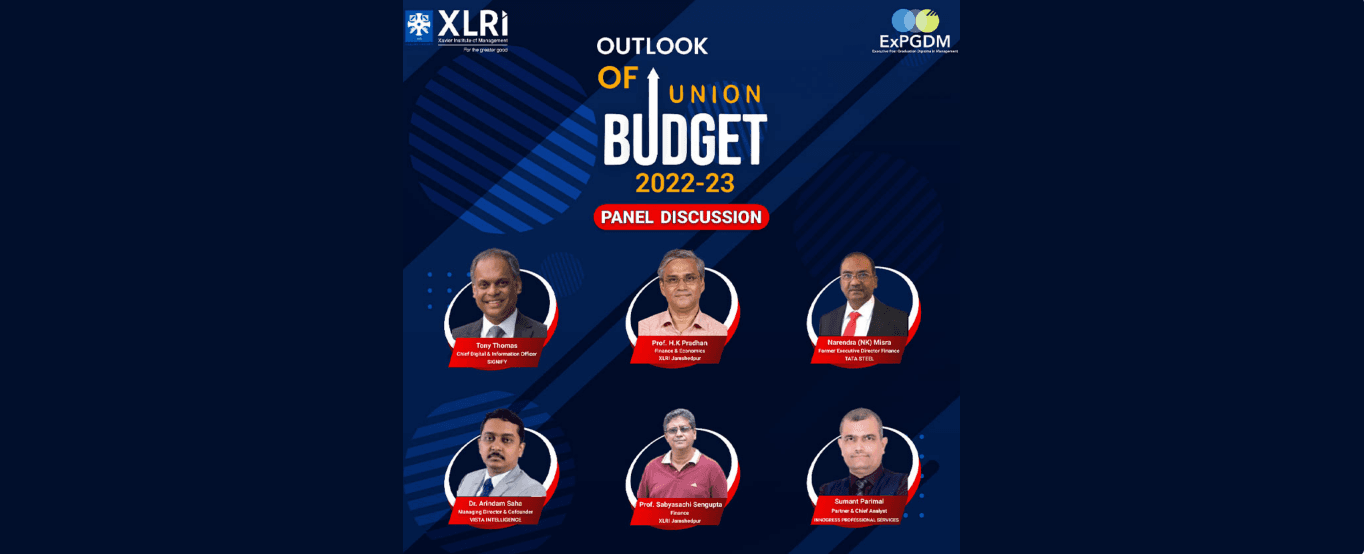
XLRI PGDM (GM) Finance Committee hosted the Panel Discussion on “Outlook of Union Budget 2022-23.” on the 7th of February 2022 at 6:00 PM. This session is to enlighten the students about the union budget, various economic reforms discussed, and the role of the Budget in economic and industry growth.
The panel members comprising of Industry experts and esteemed faculty included:
1. Narendra (NK) Misra, Former Executive Director Finance, Tata Steel,
2. Dr. Arindam Saha, Managing Director & Co-founder, Vista Intelligence
3. Sumant Parimal, Partner and Chief Analyst, Innogress Professional Services
4. Tony Thomas, Chief Digital and Information Officer, Signify
5. Prof. H. K. Pradhan, Finance & Economics, XLRI
The entire discussion was moderated by Prof. Sabyasachi Sengupta, Finance, XLRI Jamshedpur.
The event started with Prof. H. K. Pradhan setting the stage for the discussion to begin, followed by each panel member speaking about the various vital aspects of the Budget.
Mr. Narendra Misra graced us with his presence, spoke on general discussion, and credited the finance minister for presenting simple and uncomplicated budgets. He also said that the Budget is an instrument for creating stability in the system.” If we must grow, we have to have stability”. Stability helps in gaining the interest of investors. He praised the points on the Budget:
1. Capital expenditure, especially on the tremendous increase of government spending on roads and highways. He also emphasized the importance of roads and highways in the economy and towards employment.
2. No New and Disruptive Taxes
3. Extension of tax holidays to the corporates
However, he criticized the Budget for the lack practicality, not addressing BEPS(Base Erosion of Profit Share) and for not addressing climate concerns and green economies and the slow progress of disinvestments and lack of investment in the rural areas economy. He also mentioned that India is on the right track, and things like unemployment and all cannot change all of a sudden and emphasized the importance of digital initiatives, which have been mentioned in the Budget in the future.
Dr. Arindam Saha praised the Finance Minister for doing a great job as an economist, but at the time, he felt that she had not done an excellent job as a politician. He expressed concern over the 30% taxation of cryptocurrency and thought that this move is akin to legitimizing the cryptocurrency. He believed that cryptocurrency is not an ideal asset for currency since it is only digital and not backed by any underlying assets such as gold, oil, etc. He felt this taxation move would increase the trading of existing cryptocurrencies (hundreds of them) and lead to the creation of more cryptocurrencies. Moreover, he also felt that government does not have a regulatory framework to control that situation and monitor the usage of crypto as a currency.
He praised the government for the measures taken to support startups and improve the startup ecosystem in the country and considered some moves to be futuristic in nature. He also emphasized the importance of market access on startups. But he also stated there was a lack of transparency in labour laws and felt that this could have a severe impact on the startup ecosystem. He thought that several startups were failing because of their inability to retain talent, which is moving to more prominent companies after spending a short duration in the startups. He stated that the unemployment rate is alarming, and government should have done more. He raised concerns about the fiscal deficit and the falling FDI levels. He also raised concerns about the slow disinvestment process.
He criticized the Budget on agricultural reforms and felt more could have been done in this area.
Mr. Sumant Parimal spoke at length about digital initiatives aspects of the union budget. He expressed his view that India must focus on the next generation of technologies such as artificial intelligence, blockchain, metaverse, quantum computing etc. He believed that though digital technologies have helped build the consolidation in the market, increasing efficiency, productivity improvement etc., however, the actual use of technology enhances earnings and productivity manifolds. He mentioned that the budget is digital technology-friendly and praised the government’s intent for some decisive measures taken in this regard. He expressed that to achieve a 5 trillion USD economy, India must focus on a two-pronged approach – An innovation-led economy and building large global brands. He said this budget is a step in the right direction, adding there is further potential to achieve an even bigger economy for India. He mentioned that RBI will be the next innovation hub, given the drive by the government towards digital currency and the economy. He expressed his concern over the lack of appropriate regulations on digital currencies to build a sustainable ecosystem. He mentioned that India must gear up to catch up to economies such as the US and China.
Mr. Tony Thomas Budget is revolving around four priorities-Inclusive development, productivity enhancements, financing investments and the gati shakti program. An economic survey prior to the Budget showed good performance, including GST collection at an all-time high. This indicates that policy implementations are going well. In his perspective, it is a growth enabling budget. The adoption of digital technology and the launch of 5G are welcome moves. The government acknowledged cryptocurrencies as well as digital asset taxation. This removes some uncertainty in this area. He was disappointed to see the slash in asset sale target. The success of the Budget depends on both the state and central governments. He discussed PM Gati shakti, mobility, transportation, and digital transformation at length. His primary focus was the impact the Budget would have on the transportation sector. He also believes that the Budget can boost the digital ecosystem and have a digital make in India.
Prof. H.K. Pradhan talked about how the Budget takes from where it left during the last year according to him. For example, in the previous Budget, we had several policies like setting up a development financial institution and the National monetization pipeline to sell the assets in different sectors.
Despite being a pandemic hit year, our country GDP grows around 9.2%, and the level of GDP today is roughly about $2.8789 trillion. He also discusses the four pillars to drive the economy; much focus was given to MSME. The second and most important is the inclusion of the digital transformation. I think that digital impact has reached out to millions and millions in the nooks and corners of the country. Lastly, he singles out the most essential part of this Budget: the CAPEX and leveraging private investments. A lot more on the Fiscal deficit, crypto tax and overall macro picture of the country was talked about by him. According to him, the macro picture looks good for both financial stability and growth.
This discussion was followed by questions from the students. Students asked questions about the Privatization policy of the government, Taxes on Cryptocurrency, the new digital currency to be launched by RBI and the FDI policies of the government.
About XLRI Jamshedpur
XLRI Jamshedpur is a premier, private management institute in India founded in 1949 by Fr Quinn Enright, S.J. in Jamshedpur’s ‘steel city’ (www.xlri.ac.in). Over the last six decades, the institute has evolved into a top-ranking business management school of international repute with a broad portfolio of management programs and research publications. Its diverse alumni are spread around the globe and have demonstrated responsible business leadership in their organizations. XLRI continually strives to contribute to numerous organizations and institutions’ professional growth and management across various industry sectors. XLRI has been awarded prestigious International Accreditations, viz., AACSB - The Association to Advance Collegiate Schools of Business and AMBA - Association of MBAs. XLRI has also earned the National Board of Accreditation (NBA) accreditation.
For any queries regarding the event, connect to us at [email protected]
Gallery
No images to display
XLRI HOSTS UNION BUDGET DISCUSSION 2022
Outlook Of Union Budget 2022-23 Concluded Successfully On 7th February 2022
XLRI PGDM (GM) Finance Committee hosted the Panel Discussion on “Outlook of Union Budget 2022-23.” on the 7th of February 2022 at 6:00 PM. This session is to enlighten the students about the union budget, various economic reforms discussed, and the role of the Budget in economic and industry growth.
The panel members comprising of Industry experts and esteemed faculty included:
1. Narendra (NK) Misra, Former Executive Director Finance, Tata Steel,
2. Dr. Arindam Saha, Managing Director & Co-founder, Vista Intelligence
3. Sumant Parimal, Partner and Chief Analyst, Innogress Professional Services
4. Tony Thomas, Chief Digital and Information Officer, Signify
5. Prof. H. K. Pradhan, Finance & Economics, XLRI
The entire discussion was moderated by Prof. Sabyasachi Sengupta, Finance, XLRI Jamshedpur.
The event started with Prof. H. K. Pradhan setting the stage for the discussion to begin, followed by each panel member speaking about the various vital aspects of the Budget.
Mr. Narendra Misra graced us with his presence, spoke on general discussion, and credited the finance minister for presenting simple and uncomplicated budgets. He also said that the Budget is an instrument for creating stability in the system.” If we must grow, we have to have stability”. Stability helps in gaining the interest of investors. He praised the points on the Budget:
1. Capital expenditure, especially on the tremendous increase of government spending on roads and highways. He also emphasized the importance of roads and highways in the economy and towards employment.
2. No New and Disruptive Taxes
3. Extension of tax holidays to the corporates
However, he criticized the Budget for the lack practicality, not addressing BEPS(Base Erosion of Profit Share) and for not addressing climate concerns and green economies and the slow progress of disinvestments and lack of investment in the rural areas economy. He also mentioned that India is on the right track, and things like unemployment and all cannot change all of a sudden and emphasized the importance of digital initiatives, which have been mentioned in the Budget in the future.
Dr. Arindam Saha praised the Finance Minister for doing a great job as an economist, but at the time, he felt that she had not done an excellent job as a politician. He expressed concern over the 30% taxation of cryptocurrency and thought that this move is akin to legitimizing the cryptocurrency. He believed that cryptocurrency is not an ideal asset for currency since it is only digital and not backed by any underlying assets such as gold, oil, etc. He felt this taxation move would increase the trading of existing cryptocurrencies (hundreds of them) and lead to the creation of more cryptocurrencies. Moreover, he also felt that government does not have a regulatory framework to control that situation and monitor the usage of crypto as a currency.
He praised the government for the measures taken to support startups and improve the startup ecosystem in the country and considered some moves to be futuristic in nature. He also emphasized the importance of market access on startups. But he also stated there was a lack of transparency in labour laws and felt that this could have a severe impact on the startup ecosystem. He thought that several startups were failing because of their inability to retain talent, which is moving to more prominent companies after spending a short duration in the startups. He stated that the unemployment rate is alarming, and government should have done more. He raised concerns about the fiscal deficit and the falling FDI levels. He also raised concerns about the slow disinvestment process.
He criticized the Budget on agricultural reforms and felt more could have been done in this area.
Mr. Sumant Parimal spoke at length about digital initiatives aspects of the union budget. He expressed his view that India must focus on the next generation of technologies such as artificial intelligence, blockchain, metaverse, quantum computing etc. He believed that though digital technologies have helped build the consolidation in the market, increasing efficiency, productivity improvement etc., however, the actual use of technology enhances earnings and productivity manifolds. He mentioned that the budget is digital technology-friendly and praised the government’s intent for some decisive measures taken in this regard. He expressed that to achieve a 5 trillion USD economy, India must focus on a two-pronged approach – An innovation-led economy and building large global brands. He said this budget is a step in the right direction, adding there is further potential to achieve an even bigger economy for India. He mentioned that RBI will be the next innovation hub, given the drive by the government towards digital currency and the economy. He expressed his concern over the lack of appropriate regulations on digital currencies to build a sustainable ecosystem. He mentioned that India must gear up to catch up to economies such as the US and China.
Mr. Tony Thomas Budget is revolving around four priorities-Inclusive development, productivity enhancements, financing investments and the gati shakti program. An economic survey prior to the Budget showed good performance, including GST collection at an all-time high. This indicates that policy implementations are going well. In his perspective, it is a growth enabling budget. The adoption of digital technology and the launch of 5G are welcome moves. The government acknowledged cryptocurrencies as well as digital asset taxation. This removes some uncertainty in this area. He was disappointed to see the slash in asset sale target. The success of the Budget depends on both the state and central governments. He discussed PM Gati shakti, mobility, transportation, and digital transformation at length. His primary focus was the impact the Budget would have on the transportation sector. He also believes that the Budget can boost the digital ecosystem and have a digital make in India.
Prof. H.K. Pradhan talked about how the Budget takes from where it left during the last year according to him. For example, in the previous Budget, we had several policies like setting up a development financial institution and the National monetization pipeline to sell the assets in different sectors.
Despite being a pandemic hit year, our country GDP grows around 9.2%, and the level of GDP today is roughly about $2.8789 trillion. He also discusses the four pillars to drive the economy; much focus was given to MSME. The second and most important is the inclusion of the digital transformation. I think that digital impact has reached out to millions and millions in the nooks and corners of the country. Lastly, he singles out the most essential part of this Budget: the CAPEX and leveraging private investments. A lot more on the Fiscal deficit, crypto tax and overall macro picture of the country was talked about by him. According to him, the macro picture looks good for both financial stability and growth.
This discussion was followed by questions from the students. Students asked questions about the Privatization policy of the government, Taxes on Cryptocurrency, the new digital currency to be launched by RBI and the FDI policies of the government.
About XLRI Jamshedpur
XLRI Jamshedpur is a premier, private management institute in India founded in 1949 by Fr Quinn Enright, S.J. in Jamshedpur’s ‘steel city’ (www.xlri.ac.in). Over the last six decades, the institute has evolved into a top-ranking business management school of international repute with a broad portfolio of management programs and research publications. Its diverse alumni are spread around the globe and have demonstrated responsible business leadership in their organizations. XLRI continually strives to contribute to numerous organizations and institutions’ professional growth and management across various industry sectors. XLRI has been awarded prestigious International Accreditations, viz., AACSB - The Association to Advance Collegiate Schools of Business and AMBA - Association of MBAs. XLRI has also earned the National Board of Accreditation (NBA) accreditation.
For any queries regarding the event, connect to us at [email protected]
Gallery
No images to display