- Director's Message
- About The Director
- Heritage
- Founding Fathers
- Brand XLRI
- Vision and Mission
- Board of Governors
- Leadership and Administration
- Industry Advisory Council
- Programs and Equivalence
- XLRI’s Position & Ranking
- Accreditation
- Social Initiatives
- Rural Immersion
- Social Engagement Activities
- Mandatory Disclosure
- Careers Opportunities
- Internal Committee
- Student Profile
- Batch Profile
- Our Recruiters
- Create Visibility for your Firm
- Placement Overview
- Career Transformation Series
- Placement Office Team - PGDM(GM)
- PGDM (GM) Student Committee
- Alumni Speak - PGDM (GM)
- Virtual Internship
- Professional Mentorship Programme
- Guest Lecture Series
- CXO Series
- XL Forum Series
- PGDM (GM) Annual Alumni Meet - Confluence
- Conclaves, Seminars & Panel Discussion
- FAQs
- Fr Arrupe Centre for Ecology and Sustainability
- Financial Market Centre
- Centre for Human Resource Development
- Centre for Logistics & SCM
- Centre for Peace and Justice
- XLRI JRD Tata Foundation in Business Ethics
- Centre for Gender Equality and Inclusive Leadership
- Center for Public Policy and Public Affairs
- XLRI Centre for Spirituality & Human Development
- Case Research & Simulation Development Centre
- Fr McGrath Skill Development Centre
- Centre for Entrepreneurship
- Centre for Learning and Teaching Innovations
- Centre of AI Research and Application (CARA)
- XCITE
- Centre for Experiential and Gamified Experiences (EDGE)
- Centre for Global South Studies
- Centre for Excellence in Coaching & Leadership (X-CEL)
- XCEED - XLRI Incubator
Operation & supply-chain Conclave - Clockspeed
ClockSpeed 3.0 - Operation and Supply Chain Conclave
XLRI PGDM (GM) has successfully completed its Operations and Supply Chain Conclave-CLOCKSPEED 3.0 – Innovating Supply Chain for the Future on 25 th March 2023
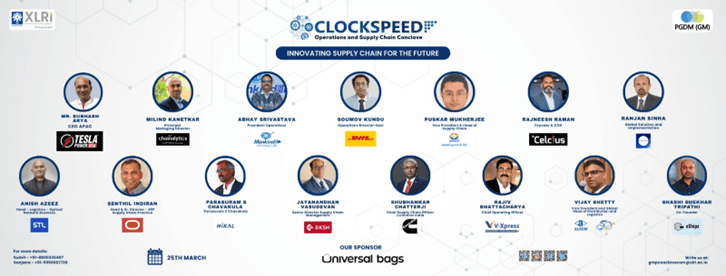
XLRI’s Conclave Committee hosted its Operations and Supply Chain Conclave – CLOCKSPEED 3.0 on 25th March 2023.
CLOCKSPEED 3.0 aims to provide a platform for sharing best industry practices and their views on what strategies the organizations can implement to navigate their organization through these turbulent times and make them future-ready through a series of interactive panel discussions and keynote addresses by industry leaders.
The event started with the lighting of the lamp which was done by Prof. Kanagaraj Ayyalusamy, Prof. Alok Raj, and all the delegates.
The conclave was held hybrid – offline pre-lunch and online post-lunch with Ms. Sanjana Varshney, Mr. Mohammed Adeeb, and Mr. Shivank Chaudaury as student moderators. Students Ms. Sarayu Nair, Ms. Shilpita Panigrahy, Mr. Sohrab Faraz, and Mr. Nishit Rastogi were hosts and co-hosts for the event.
The event started with the inaugural address by Prof. Alok Raj, XLRI Jamshedpur. In his address, he highlighted the importance of collaboration between industry and academia. He emphasizes the significance of involving students in this partnership, as they are the future employees and leaders who will drive innovation and progress in the industry. Conclaves like the one being held can serve as the starting point for a meaningful dialogue between academia and industry. Through this dialogue, both parties can exchange ideas, share knowledge, and work towards developing innovative solutions to real-world challenges. Prof. Raj's mention of Indian business moving towards global practice underscores the need for academia to play a crucial role in shaping the cutting-edge practices of tomorrow. By collaborating with industry and staying abreast of the latest trends and developments, academia can contribute significantly to the growth and success of Indian businesses.
This was followed by the Chief Guest Speaker Mr. Subhash Arya, CEO APAC, TESLA POWER USA. He stressed that Supply chain Management is the backbone of the world’s functioning. We should think globally but definitely take the local environment into consideration while taking decisions. The speed of execution is important in Supply chain management, and technology plays a very important role in demand capturing and many other Supply chain activities.
This was followed by a panel discussion on the topic “Supply Chain Analytics: Shaping the future of Logistics and Supply Chain Management”, moderated byMs. Sanjana Varshney, PGDM (GM) XLRI Jamshedpur, with the panelists:
- Mr. Milind Kanetkar, Managing Director / Principal Chainalytics
- Mr. Abhay Srivastava, President Operations Mankind Pharma Ltd
- Mr. Soumov Kundu, Operations Director- East, DHL Supply Chain India Pvt. Ltd.
- Mr. Puskar Mukherjee, Vice President & Head of Supply Chain, Emami Agrotech Ltd.
- Mr. Rajneesh Raman, Founder & COO, Celcius Logistics Solutions Pvt Ltd.,
Mr. Milind Kanetkar gave importance to google mobility. The need of the customers can be determined by Analytics and the company should focus on executing and implementing that. Learning and mitigating risks associated with data should be facilitated, and processes should be developed accordingly.
Mr. Abhay Srivastava shed light on the challenges faced by the supply chain environment and the evolution of risk assessment in the business world. He notes that risk management used to be a peripheral concern in board meetings, but it has become a critical business need over time. With the COVID-19 pandemic, risk has become even more prominent and quantifiable, leading to its inclusion as a key performance indicator (KPI) in company reports.
Mr. Soumov Kundu mentioned that “In the application of Data analytics there are two parts: The machine side and the Human side. When we are spending money on ML, we are spending money on the analysis and presentation of the data. But they are still data points. The insights to be derived from the whole exercise is where the human side comes up.”
Mr. Puskar Mukherjee stated that analytics must be integrated into the company's overall strategy, not just the supply chain strategy, and that ownership should flow from the bottom up. Every firm is actively pursuing a move to data-driven analytics. He emphasized that all company errors are costly, but supply chain process errors are far more so. Also, he emphasized the importance of business cases for conducting ESG and data initiatives. Whether to pursue the analysis of the past or adopt analytics for the future remains a topic of ongoing debate.
Mr. Rajneesh Raman highlighted that more than the analysis of the data, the source of the data is important. He emphasized that for any certain decision implementation, the authenticity of the data is of much importance otherwise it may lead to failure. He talked about how organizations should be aware of how to utilize data points. The utilization of software used for data analysis should be made keeping in mind small businesses. At times, such businesses become a victim of short-term vision and don’t focus on long-term gains, hence, such software targeted toward small businesses would help the ecosystem.
The second half of the conclave started with moderation by Mr. Mohammed Adeeb, PGDM (GM) XLRI Jamshedpur on the topic: Importance of ESG in Supply Chain Management with the panelists
- Mr. Ranjan Sinha, Global Solution, and Implementation, Envision Enterprise Solutions America Inc
- Mr. Senthil Indiran, Head & Sr. Director – ERP Supply Chain Practice, Oracle Global Services Center.
- Mr. Parasuram S. Chavakula, Vice President & Head Supply Chain, Hikal Ltd.
Mr. Ranjan Sinha stressed the need to adopt sustainable business practices for the companies. He said that “ESG principles should be inculcated into the product design phase to identify the ESG-related risks with the lifecycle of the concerned product. The selection of raw materials for a product design has an enormous impact on the carbon footprint of the product concerned. Use of principles of Circular Economy can further enhance the sustainability of that concerned product.”
Mr. Senthil Indiran mentioned “ESG’s main motive is to ensure that the business conducts their business responsibility. So, the overall idea is that society benefits, and we are doing all the right things in all three aspects of the environment, society, and having the right governance policy. He also mentioned “The first important benefit for business is the continuity of the business with your customers. We should look at it from the risk perspective and see if we are going to lose business if we do not adopt this way “
Mr. Parasuram S. Chavakula emphasized that ESG may initially be perceived as a cost, but it will result in long-term value and that ESG has become a differentiating factor for businesses today. He underlined the importance of evaluating the current circumstances and developing short- and long-term organizational objectives based on this evaluation. In addition, he stressed how firms strive to exceed regulatory standards because they understand the importance of business continuity and further discussed how risk assessment and mitigation have evolved into an ongoing process.
This was followed by a panel discussion moderated byMr. Shivank Chaudhary, PGDM (GM) XLRI Jamshedpur on the topic: Global Supply Chain Collaboration through transparency with the panelists:
- Mr. Shubhankar Chatterji, Chief Supply Chain Officer, Cummins India Ltd
- Mr. Rajiv Bhattacharya, Chief Operating Officer, V-Xpress (A Div. of V-Trans India Ltd)
- Mr. Vijay Shetty, Vice President & Head Supply Chain, Hikal Ltd.
- Mr. Shashi Shekhar Tripathi, Co-Founder, eShipz.com
Mr. Shubhankar Chatterji stated “In this very VUCA world, if organizations have to stay ahead in the world, they need to be the winner in transparency across all the factors. Sharing of data, strategies, and technologies should be across the value chain. Trust should be built across the value chain for transparency to existing in the organization with the common aim of winning together. Using prevalent technologies, Blockchain, RFID, GPS, and AI for the product's traction from end to end has become a mandate throughout the Value Chain. The use of these technologies also makes data access transparent throughout the organization.”
Mr. Rajiv Bhattacharya emphasized the significance of maintaining transparency throughout the supply chain, domestically and internationally. The second essential factor is establishing stakeholder trust and connecting organizational objectives with it. He stated that since technology is at the forefront of the Supply Chain today, visibility and transparency of all data and product movement are paramount. Using technologies like Blockchain and API facilitates automation, that is leading to a better-controlled environment where inventory levels can be predicted. The use of blockchain in the Supply chain is in its infancy, but it has a promising future.
Mr. Vijay Shetty talked about the need for close coordination and cooperation between the various verticals of SCM, Production, Marketing & Sales to efficiently fulfill customer demands. He also said that the “Use of technology can increase the operational efficiency of a company.” He highlighted the advantages of integration of ERP systems of a company and its Distributors. This provides the company the information about its product stock availability in the market with its distributors. This in turn enables companies to optimize their demand forecasting models and production plans.
Mr. Shashi Shekhar Tripathi highlighted that tools and technology are required to increase visibility and trust between the company and the supplier. Eventually, these factors will enhance the supply chain efficiency and reduce environmental impact. He shared multiple real-life examples from his rich experience and the latest work methodologies (empowered by multiple technologies) used in eShipz.com to connect the dots between different parties and update customers with real-time progress. He emphasized the importance of a consolidated approach that connects the system and empowers everyone (Stakeholders).
The grand event was concluded with a Vote of Thanks by Mr. Akash Raj Shukla, General Secretary, Placement Committee of XLRI summarizing the whole session & bringing it to a delightful close. The event was organized seamlessly under the able guidance of Prof. Kanagaraj Ayyalusamy & Mr. Shownu Winstington and the entire Conclave Committee.
Gallery
No images to display
Operation & supply-chain Conclave - Clockspeed
ClockSpeed 2.0 - Operation and Supply Chain Conclave
XLRI PGDM (GM) has successfully completed its Flagship Operations & Supply Chain Conclave
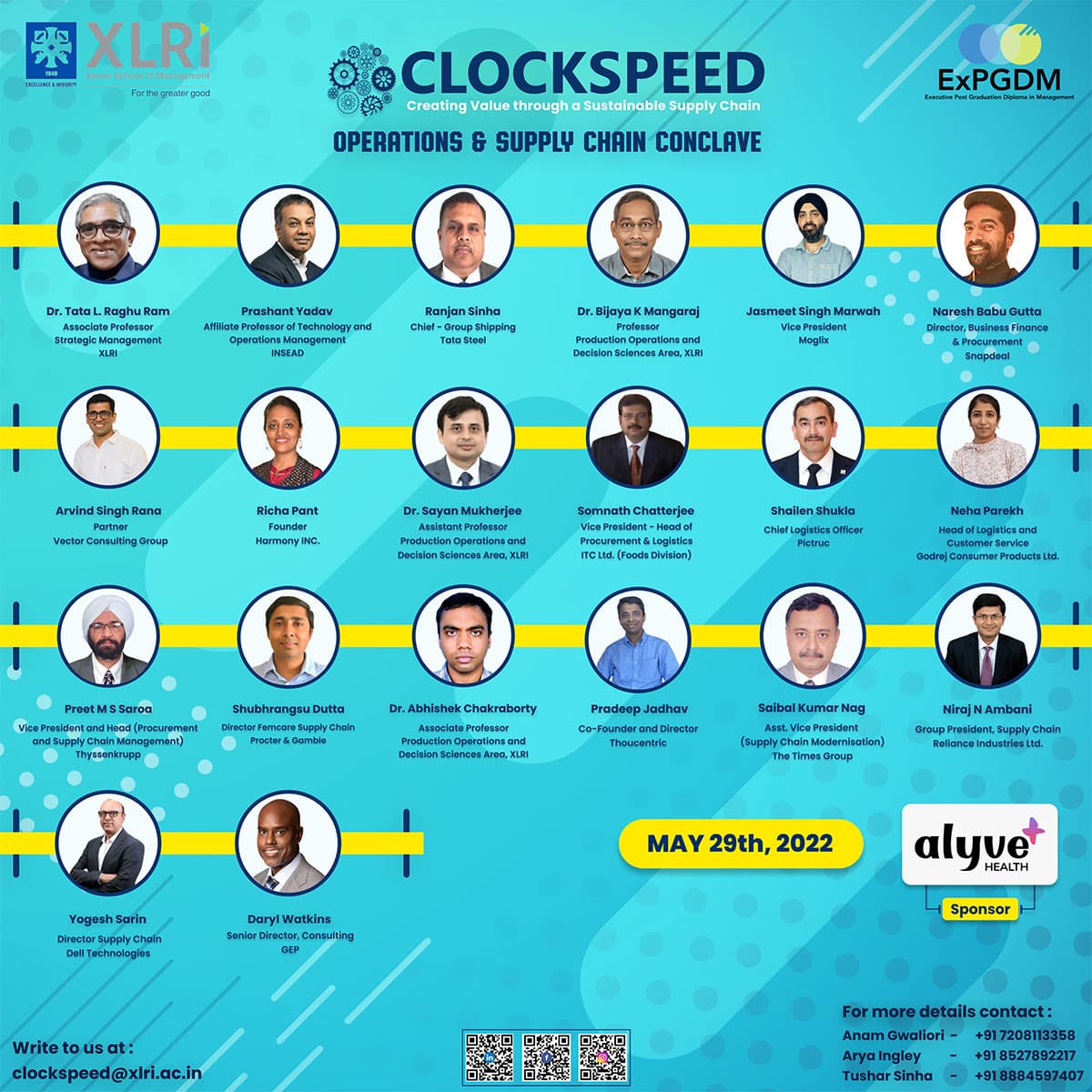
COVID-19, the resulting economic crisis, and climate-change challenges have put the spotlight on Sustainability and how it is not just a priority for companies but also for investors and consumers. For most companies, the supply chains are responsible for the bulk of their environmental and societal impact. Companies have managed to reduce costs, protect their market shares, and reduce risks by actively responding to sustainability disruptions in the supply chain.
ClockSpeed 2.0 aims to provide a platform for sharing best industry practices for overcoming disruptions in the supply chain. The Event was packed with a series of Guest Lecture sessions, interactive panel discussions, exciting case competitions, and keynote addresses by an eclectically assembled list of industry leaders and Supply Chain practitioners.
The Conclave started with an Inaugural Address by Dr. Tata L. Raghu Ram, Chairperson of Father Arrupe Centre for Ecology & Sustainability and Associate Professor of Strategic Management at XLRI Jamshedpur. It was followed by the Chief Guest Address by Mr. Prashant Yadav, Affiliate Professor of Technology and Operations Management, INSEAD on Musings on Supply Chains that Save Lives and Improve Sustainability. This was followed by a Keynote Address by Mr. Ranjan Sinha, Chief Group Shipping, Tata Steel on the topic ‘Volatility, Uncertainty, Complexity & Ambiguity: How to best position people, processes and technology to define supply chain vision for 2025 and beyond’.
The next came a panel discussion on the topic: ‘Do Supply Chains run the risk of Disruption due to ESG concerns?’. The session was moderated by Dr. Bijaya K Mangaraj, Professor – Production, Operations and Decision Sciences, XLRI Jamshedpur. This eclectic panel comprised of Mr. Jasmeet Singh Marwah, Vice President, Moglix, Mr. Naresh Babu Gutta, Director- Business Finance and Procurement, Snapdeal, Mr. Arvind Singh Rana, Partner, Vector Consulting Group, Ms. Richa Pant, Founder, Harmony Inc.
This was followed by a second panel discussion on the topic: ‘Can Digital accelerate our Journey to Net Zero?’ moderated by Dr. Sayan Mukherjee, Assistant Professor – Production, Operations and Decision Sciences, XLRI Jamshedpur. This panel featured Mr. Somnath Chatterjee, Vice President - Head of Procurement & Logistics, ITC Limited, Mr. Shailen Shukla, Chief Logistics Officer, MHAO (Mohamed Hareb Al Otaiba) Group, Ms. Neha Parekh, Head of Logistics, Godrej Consumer Products Ltd., Mr. Preet M S Saroa, VP and Head, Supply Chain and Procurement, Thyssenkrupp.
The next session featured a Keynote Address by Mr. Shubhrangsu Dutta, Director- Femcare Supply Chain, Procter & Gamble on the topic ‘Supply Chain Resilience’. This session covered critical insights on the core elements of budling resilience within supply chains across the board. This session was followed by the last panel on the Topic: ‘Will Sustainability bind Leaders, Customers and Investors to seek long-term Value?’. It was moderated by Dr. Abhishek Chakraborty, Associate Professor – Production, Operations and Decision Sciences, XLRI Jamshedpur. This panel featured dynamic leaders including Mr. Niraj N Ambani, Group President- Supply Chain, Reliance Industries Limited, Mr. Pradeep Jadhav, Co-Founder & Director, Thoucentric and Mr. Saibal Kumar Nag, Asst. Vice President (Supply Chain Modernization), Bennett Coleman and Co. Ltd. (Times Group).
This session was followed by a session by Mr. Yogesh Sarin, Director- Supply Chain, Dell Technologies on Supply Chain Transformations. The session shared insights on the core drivers of transformation in Supply chains and the vital role of analytics, digitalization and resilience in attaining operational excellence while driving sustainability.
Unlocking ESG within Supply Chain was the next session, led by Mr. Daryl Watkins, Senior Director- Supply Chain, GEP Worldwide USA, discussing the topic ESG within the Supply Chain.
The grand event concluded with a vote of thanks by Ms. Anam Gwaliori, General Secretary, Placement Committee summarising the whole session.
Gallery
No images to display
Operation & supply-chain Conclave - Clockspeed
ClockSpeed 3.0 - Operation and Supply Chain Conclave
XLRI PGDM (GM) has successfully completed its Operations and Supply Chain Conclave-CLOCKSPEED 3.0 – Innovating Supply Chain for the Future on 25 th March 2023
XLRI’s Conclave Committee hosted its Operations and Supply Chain Conclave – CLOCKSPEED 3.0 on 25th March 2023.
CLOCKSPEED 3.0 aims to provide a platform for sharing best industry practices and their views on what strategies the organizations can implement to navigate their organization through these turbulent times and make them future-ready through a series of interactive panel discussions and keynote addresses by industry leaders.
The event started with the lighting of the lamp which was done by Prof. Kanagaraj Ayyalusamy, Prof. Alok Raj, and all the delegates.
The conclave was held hybrid – offline pre-lunch and online post-lunch with Ms. Sanjana Varshney, Mr. Mohammed Adeeb, and Mr. Shivank Chaudaury as student moderators. Students Ms. Sarayu Nair, Ms. Shilpita Panigrahy, Mr. Sohrab Faraz, and Mr. Nishit Rastogi were hosts and co-hosts for the event.
The event started with the inaugural address by Prof. Alok Raj, XLRI Jamshedpur. In his address, he highlighted the importance of collaboration between industry and academia. He emphasizes the significance of involving students in this partnership, as they are the future employees and leaders who will drive innovation and progress in the industry. Conclaves like the one being held can serve as the starting point for a meaningful dialogue between academia and industry. Through this dialogue, both parties can exchange ideas, share knowledge, and work towards developing innovative solutions to real-world challenges. Prof. Raj's mention of Indian business moving towards global practice underscores the need for academia to play a crucial role in shaping the cutting-edge practices of tomorrow. By collaborating with industry and staying abreast of the latest trends and developments, academia can contribute significantly to the growth and success of Indian businesses.
This was followed by the Chief Guest Speaker Mr. Subhash Arya, CEO APAC, TESLA POWER USA. He stressed that Supply chain Management is the backbone of the world’s functioning. We should think globally but definitely take the local environment into consideration while taking decisions. The speed of execution is important in Supply chain management, and technology plays a very important role in demand capturing and many other Supply chain activities.
This was followed by a panel discussion on the topic “Supply Chain Analytics: Shaping the future of Logistics and Supply Chain Management”, moderated byMs. Sanjana Varshney, PGDM (GM) XLRI Jamshedpur, with the panelists:
- Mr. Milind Kanetkar, Managing Director / Principal Chainalytics
- Mr. Abhay Srivastava, President Operations Mankind Pharma Ltd
- Mr. Soumov Kundu, Operations Director- East, DHL Supply Chain India Pvt. Ltd.
- Mr. Puskar Mukherjee, Vice President & Head of Supply Chain, Emami Agrotech Ltd.
- Mr. Rajneesh Raman, Founder & COO, Celcius Logistics Solutions Pvt Ltd.,
Mr. Milind Kanetkar gave importance to google mobility. The need of the customers can be determined by Analytics and the company should focus on executing and implementing that. Learning and mitigating risks associated with data should be facilitated, and processes should be developed accordingly.
Mr. Abhay Srivastava shed light on the challenges faced by the supply chain environment and the evolution of risk assessment in the business world. He notes that risk management used to be a peripheral concern in board meetings, but it has become a critical business need over time. With the COVID-19 pandemic, risk has become even more prominent and quantifiable, leading to its inclusion as a key performance indicator (KPI) in company reports.
Mr. Soumov Kundu mentioned that “In the application of Data analytics there are two parts: The machine side and the Human side. When we are spending money on ML, we are spending money on the analysis and presentation of the data. But they are still data points. The insights to be derived from the whole exercise is where the human side comes up.”
Mr. Puskar Mukherjee stated that analytics must be integrated into the company's overall strategy, not just the supply chain strategy, and that ownership should flow from the bottom up. Every firm is actively pursuing a move to data-driven analytics. He emphasized that all company errors are costly, but supply chain process errors are far more so. Also, he emphasized the importance of business cases for conducting ESG and data initiatives. Whether to pursue the analysis of the past or adopt analytics for the future remains a topic of ongoing debate.
Mr. Rajneesh Raman highlighted that more than the analysis of the data, the source of the data is important. He emphasized that for any certain decision implementation, the authenticity of the data is of much importance otherwise it may lead to failure. He talked about how organizations should be aware of how to utilize data points. The utilization of software used for data analysis should be made keeping in mind small businesses. At times, such businesses become a victim of short-term vision and don’t focus on long-term gains, hence, such software targeted toward small businesses would help the ecosystem.
The second half of the conclave started with moderation by Mr. Mohammed Adeeb, PGDM (GM) XLRI Jamshedpur on the topic: Importance of ESG in Supply Chain Management with the panelists
- Mr. Ranjan Sinha, Global Solution, and Implementation, Envision Enterprise Solutions America Inc
- Mr. Senthil Indiran, Head & Sr. Director – ERP Supply Chain Practice, Oracle Global Services Center.
- Mr. Parasuram S. Chavakula, Vice President & Head Supply Chain, Hikal Ltd.
Mr. Ranjan Sinha stressed the need to adopt sustainable business practices for the companies. He said that “ESG principles should be inculcated into the product design phase to identify the ESG-related risks with the lifecycle of the concerned product. The selection of raw materials for a product design has an enormous impact on the carbon footprint of the product concerned. Use of principles of Circular Economy can further enhance the sustainability of that concerned product.”
Mr. Senthil Indiran mentioned “ESG’s main motive is to ensure that the business conducts their business responsibility. So, the overall idea is that society benefits, and we are doing all the right things in all three aspects of the environment, society, and having the right governance policy. He also mentioned “The first important benefit for business is the continuity of the business with your customers. We should look at it from the risk perspective and see if we are going to lose business if we do not adopt this way “
Mr. Parasuram S. Chavakula emphasized that ESG may initially be perceived as a cost, but it will result in long-term value and that ESG has become a differentiating factor for businesses today. He underlined the importance of evaluating the current circumstances and developing short- and long-term organizational objectives based on this evaluation. In addition, he stressed how firms strive to exceed regulatory standards because they understand the importance of business continuity and further discussed how risk assessment and mitigation have evolved into an ongoing process.
This was followed by a panel discussion moderated byMr. Shivank Chaudhary, PGDM (GM) XLRI Jamshedpur on the topic: Global Supply Chain Collaboration through transparency with the panelists:
- Mr. Shubhankar Chatterji, Chief Supply Chain Officer, Cummins India Ltd
- Mr. Rajiv Bhattacharya, Chief Operating Officer, V-Xpress (A Div. of V-Trans India Ltd)
- Mr. Vijay Shetty, Vice President & Head Supply Chain, Hikal Ltd.
- Mr. Shashi Shekhar Tripathi, Co-Founder, eShipz.com
Mr. Shubhankar Chatterji stated “In this very VUCA world, if organizations have to stay ahead in the world, they need to be the winner in transparency across all the factors. Sharing of data, strategies, and technologies should be across the value chain. Trust should be built across the value chain for transparency to existing in the organization with the common aim of winning together. Using prevalent technologies, Blockchain, RFID, GPS, and AI for the product's traction from end to end has become a mandate throughout the Value Chain. The use of these technologies also makes data access transparent throughout the organization.”
Mr. Rajiv Bhattacharya emphasized the significance of maintaining transparency throughout the supply chain, domestically and internationally. The second essential factor is establishing stakeholder trust and connecting organizational objectives with it. He stated that since technology is at the forefront of the Supply Chain today, visibility and transparency of all data and product movement are paramount. Using technologies like Blockchain and API facilitates automation, that is leading to a better-controlled environment where inventory levels can be predicted. The use of blockchain in the Supply chain is in its infancy, but it has a promising future.
Mr. Vijay Shetty talked about the need for close coordination and cooperation between the various verticals of SCM, Production, Marketing & Sales to efficiently fulfill customer demands. He also said that the “Use of technology can increase the operational efficiency of a company.” He highlighted the advantages of integration of ERP systems of a company and its Distributors. This provides the company the information about its product stock availability in the market with its distributors. This in turn enables companies to optimize their demand forecasting models and production plans.
Mr. Shashi Shekhar Tripathi highlighted that tools and technology are required to increase visibility and trust between the company and the supplier. Eventually, these factors will enhance the supply chain efficiency and reduce environmental impact. He shared multiple real-life examples from his rich experience and the latest work methodologies (empowered by multiple technologies) used in eShipz.com to connect the dots between different parties and update customers with real-time progress. He emphasized the importance of a consolidated approach that connects the system and empowers everyone (Stakeholders).
The grand event was concluded with a Vote of Thanks by Mr. Akash Raj Shukla, General Secretary, Placement Committee of XLRI summarizing the whole session & bringing it to a delightful close. The event was organized seamlessly under the able guidance of Prof. Kanagaraj Ayyalusamy & Mr. Shownu Winstington and the entire Conclave Committee.
Gallery
No images to display
Operation & supply-chain Conclave - Clockspeed
ClockSpeed 2.0 - Operation and Supply Chain Conclave
XLRI PGDM (GM) has successfully completed its Flagship Operations & Supply Chain Conclave
COVID-19, the resulting economic crisis, and climate-change challenges have put the spotlight on Sustainability and how it is not just a priority for companies but also for investors and consumers. For most companies, the supply chains are responsible for the bulk of their environmental and societal impact. Companies have managed to reduce costs, protect their market shares, and reduce risks by actively responding to sustainability disruptions in the supply chain.
ClockSpeed 2.0 aims to provide a platform for sharing best industry practices for overcoming disruptions in the supply chain. The Event was packed with a series of Guest Lecture sessions, interactive panel discussions, exciting case competitions, and keynote addresses by an eclectically assembled list of industry leaders and Supply Chain practitioners.
The Conclave started with an Inaugural Address by Dr. Tata L. Raghu Ram, Chairperson of Father Arrupe Centre for Ecology & Sustainability and Associate Professor of Strategic Management at XLRI Jamshedpur. It was followed by the Chief Guest Address by Mr. Prashant Yadav, Affiliate Professor of Technology and Operations Management, INSEAD on Musings on Supply Chains that Save Lives and Improve Sustainability. This was followed by a Keynote Address by Mr. Ranjan Sinha, Chief Group Shipping, Tata Steel on the topic ‘Volatility, Uncertainty, Complexity & Ambiguity: How to best position people, processes and technology to define supply chain vision for 2025 and beyond’.
The next came a panel discussion on the topic: ‘Do Supply Chains run the risk of Disruption due to ESG concerns?’. The session was moderated by Dr. Bijaya K Mangaraj, Professor – Production, Operations and Decision Sciences, XLRI Jamshedpur. This eclectic panel comprised of Mr. Jasmeet Singh Marwah, Vice President, Moglix, Mr. Naresh Babu Gutta, Director- Business Finance and Procurement, Snapdeal, Mr. Arvind Singh Rana, Partner, Vector Consulting Group, Ms. Richa Pant, Founder, Harmony Inc.
This was followed by a second panel discussion on the topic: ‘Can Digital accelerate our Journey to Net Zero?’ moderated by Dr. Sayan Mukherjee, Assistant Professor – Production, Operations and Decision Sciences, XLRI Jamshedpur. This panel featured Mr. Somnath Chatterjee, Vice President - Head of Procurement & Logistics, ITC Limited, Mr. Shailen Shukla, Chief Logistics Officer, MHAO (Mohamed Hareb Al Otaiba) Group, Ms. Neha Parekh, Head of Logistics, Godrej Consumer Products Ltd., Mr. Preet M S Saroa, VP and Head, Supply Chain and Procurement, Thyssenkrupp.
The next session featured a Keynote Address by Mr. Shubhrangsu Dutta, Director- Femcare Supply Chain, Procter & Gamble on the topic ‘Supply Chain Resilience’. This session covered critical insights on the core elements of budling resilience within supply chains across the board. This session was followed by the last panel on the Topic: ‘Will Sustainability bind Leaders, Customers and Investors to seek long-term Value?’. It was moderated by Dr. Abhishek Chakraborty, Associate Professor – Production, Operations and Decision Sciences, XLRI Jamshedpur. This panel featured dynamic leaders including Mr. Niraj N Ambani, Group President- Supply Chain, Reliance Industries Limited, Mr. Pradeep Jadhav, Co-Founder & Director, Thoucentric and Mr. Saibal Kumar Nag, Asst. Vice President (Supply Chain Modernization), Bennett Coleman and Co. Ltd. (Times Group).
This session was followed by a session by Mr. Yogesh Sarin, Director- Supply Chain, Dell Technologies on Supply Chain Transformations. The session shared insights on the core drivers of transformation in Supply chains and the vital role of analytics, digitalization and resilience in attaining operational excellence while driving sustainability.
Unlocking ESG within Supply Chain was the next session, led by Mr. Daryl Watkins, Senior Director- Supply Chain, GEP Worldwide USA, discussing the topic ESG within the Supply Chain.
The grand event concluded with a vote of thanks by Ms. Anam Gwaliori, General Secretary, Placement Committee summarising the whole session.
Gallery
No images to display
Operation & supply-chain Conclave - Clockspeed
ClockSpeed 1.0 - Operation and Supply Chain Conclave
XLRI Jamshedpur's PGDM(GM) batch successfully concluded Clockspeed 1.0, its annual flagship Operations and Supply Chain Conclave, held on January 30th, in association with the Association of Supply Chain Professionals (ASCP). The event began with an inauguration by Fr. Christie, Director, XLRI Jamshedpur who spoke in depth about the importance of ethics in supply chain management, and a theme address by Dr. TAS Vijayaraghavan, Chairperson, Centre for Supply Chain Management, XLRI Jamshedpur, who later said that the Conclave "addressed the very important area which many SCM conferences don't focus on so far - diversity and inclusion, which will steer the future course of action in SCM enabled with technological innovations!".
What followed was a highly illuminating discussion on Inclusion and Empowerment: Tapping an Untapped Resource, led by Ms. Swastika Basu, Chief - Enterprise Risk Management, Tata Steel, and Ms. Anasuya Ray, Director - Corporate Affairs, Mars Wrigley. After a highly interactive QnA session, the PGDM(GM) students of XLRI Jamshedpur presented original research on Diversity and Inclusion in Supply Chain Management based on extensive industry survey.
Mr. Amitava Bakshi, Chief Procurement Officer, Tata Steel, and President, Association of Supply Chain Professionals, which has played an instrumental role in promoting the development of the SCM fraternity, formally launched the ASCP Chronicle, who said that the Conclave organized by XLRI "could not come at a more appropriate time - the discussions on challenges and opportunities for Supply Chain to create value in the industry during pandemic times would have given a wealth of insight to the students."
This was followed by the Keynote Address delivered by Prof. Edward Sweeney, Professor of Logistics and Systems Head, Department of Engineering Systems and Supply Chain Management, College of Engineering and Physical Sciences, Aston University, UK.
What followed was a series of thought-provoking sessions on Future-Proofing Supply Chains Through Technology and Inclusion, by an illustrious panel including Dr. Ravi Prakash Mathur, Vice President, Supply Chain Management, Dr. Reddy's Laboratories Ltd., Mr. Subrata Basak, Chief Logistics Officer, Tata Steel BSL, Mr. Matheen Sait, Supply Chain Manager - Logistics EMEA, 3M, and Mr. Kaustav Sen, Partner, Business Consulting, KPMG.
The speakers and guests got a glimpse into the future of supply chain leadership as the National Winners of the Clockspeed Case Presentation, selected from a highly competitive pool of over 1700 registrations, presented their solutions to a live case study, created in collaboration with Jubilant Foodworks.
The day was summarized by Convener, Clockspeed 1.0 and Head of the Organizing Committee Ayush Kumar, who described the XLRI spirit as a "desire to keep learning and building a confluence of ideas, whether in-person or virtually".
The Vote of Thanks was delivered by Prof. Kanagaraj, Chairperson, GMP Placements, XLRI Jamshedpur, who called the event 'an unqualified success executed brilliantly by this cohort of future leaders.'
Media Coverage
Gallery
No images to display