- Director's Message
- About The Director
- Heritage
- Founding Fathers
- Brand XLRI
- Vision and Mission
- Board of Governors
- Leadership and Administration
- Industry Advisory Council
- Programs and Equivalence
- XLRI’s Position & Ranking
- Accreditation
- Social Initiatives
- Rural Immersion
- Social Engagement Activities
- Mandatory Disclosure
- Careers Opportunities
- Internal Committee
- Student Profile
- Batch Profile
- Our Recruiters
- Create Visibility for your Firm
- Placement Overview
- Career Transformation Series
- Placement Office Team - PGDM(GM)
- PGDM (GM) Student Committee
- Alumni Speak - PGDM (GM)
- Virtual Internship
- Professional Mentorship Programme
- Guest Lecture Series
- CXO Series
- XL Forum Series
- PGDM (GM) Annual Alumni Meet - Confluence
- Conclaves, Seminars & Panel Discussion
- FAQs
- Fr Arrupe Centre for Ecology and Sustainability
- Financial Market Centre
- Centre for Human Resource Development
- Centre for Logistics & SCM
- Centre for Peace and Justice
- XLRI JRD Tata Foundation in Business Ethics
- Centre for Gender Equality and Inclusive Leadership
- Center for Public Policy and Public Affairs
- XLRI Centre for Spirituality & Human Development
- Case Research & Simulation Development Centre
- Fr McGrath Skill Development Centre
- Centre for Entrepreneurship
- Centre for Learning and Teaching Innovations
- Centre of AI Research and Application (CARA)
- XCITE
- Centre for Experiential and Gamified Experiences (EDGE)
- Centre for Global South Studies
- Centre for Excellence in Coaching & Leadership (X-CEL)
- XCEED - XLRI Incubator
Avensis International CEO conclave
XLRI PGDM (GM) has successfully completed its International CEO Conclave- AVENSIS on 17th and 18th February 2023
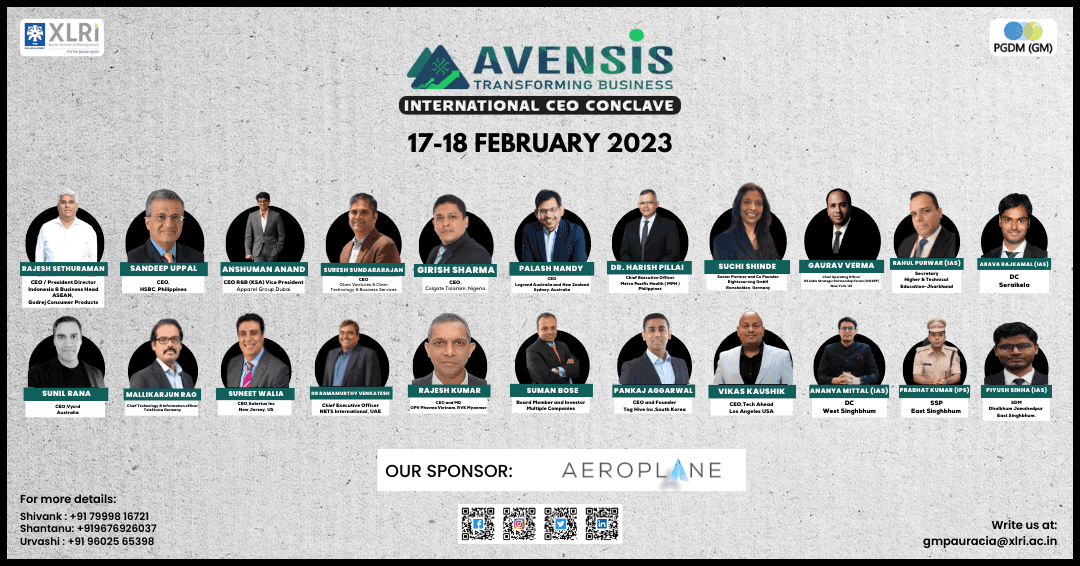
XLRI’s Auracia Club inaugurated its International CEO Conclave – Avensis on 17th February 2023 with dignitaries from the Administrative Services sharing their significant and thought-provoking experiences on the topic “Leadership at Grassroot Level”.
The event started with the lighting of the lamp that was done by Father George, Father Donald, Prof Sanjay Patro, Prof. A Kanagaraj, Mr Rajni Ranjan and the dignitaries.
It started with the Keynote Address by Mr. Rahul Purwar (IAS), Secretary- Higher & Technical Education- Jharkhand, where he shared his views on Sustainability as a means of long term that is a right blend of approaching all three aspects – People, Purpose, and Planet. He shared his views that Sustainability is beyond just solutions. We need to introspect what that situation that demands and tailor an approach that can be a beginning to long-lasting transformation. He emphasised the necessity to design changes in such a way that those changes enable an organisation to solve the present problems and prepare the organisation for any changes that might come in the future. He further went on to highlight the importance of designing process changes in an organisation which are sustainable. The sustainability of any process can be ensured only if the three segments of stakeholders- Customers, Employees and Community are kept in mind while designing any process changes.
He concluded his speech by saying that private and government entities contribute equally to society. Both, government, and private entities should focus on the well-being of the customers, employees, and community to add value to the society.
It was followed by Fireside Chat –on Topic “Leadership at Grassroot Level”. The Panel comprised of: -
- Mr. Rahul Purwar (IAS) - Secretary- Higher & Technical Education- Jharkhand
- Mr. Arava Rajkamal (IAS) - DC- Seraikela
- Mr. Ananya Mittal (IAS) - DC - West Singhbhum
- Mr. Prabhat Kumar (IPS) - SSP East Singhbhum
- Mr. Piyush Sinha (IAS) - SDM Dhalbhum Jamshedpur East Singhbhum
Mr. Arava Rajkamal shared his views on his journey as an officer stating that his love for economics. He shared economics is to policy is what physics is to engineer so even for business for that matter is exactly what physics is to engineer so it gives you a perspective to analyse every event. He emphasized that intuition development was the best part of learning, aiding in quantifying human and firm behaviour. Regarding his experience, "Each posting is a challenging experience, and you learn something new." He also emphasized that the likelihood of failure decreases when multiple layers of leadership exist.
Mr. Prabhat Kumar shared with how inculcating leadership is a challenging process, he emphasized on we are living in a world where resources are limited and the people, we are dealing with might have limited capabilities. Mr. Prabhat talks about how these challenges can be overcome by bringing uniformity in the process and aligning the team to changing technologies. He also talked about importance of bridging the gap between public and police force. Mr. Prabhat talked about how technology is helping to bridge that gap and requested the future leaders from XLRI to work on solving the problems of rural India. He further added that going forward they were to launch a chatbot that would help people retrieve their lost phones and save them the difficulty to go to the police station to file a report. The number is 9006123444. He shared that they have taken this unique number so nobody has to go to a police station after this for restoring mobile loss. They have also used the Word “JOHAR” in their chatbot to make it more relatable for the common people. This will directly go to their technical centre in his office, & you will be contacted I the phone is found.
Mr. Ananya Mittal shared that the importance of some time to self-reflect and think upon things that you usually miss out on in this busy lifestyle. He focused on the importance of work life balance and how he chooses to keep his best focus at work during work hours to balance his personal life as well. He shared that his experience. Regarding his experience on the move to Jharkhand he shared his views as “Today most of the business acumen being used to solve are for urban centric problems. Being from Delhi and coming to Jharkhand has given the new prospective. Taking the example of mid-day meal program in the rural India, there is numerous opportunities for new business ideas, numerous avenues to solve. There is a huge scale that is already present. Its up to ideation and the utilization that can add more value. “He also shares with examples from his experience that “In leadership, appreciation is very important. It inspires to take on more challenges.”
Mr. Piyush Sinha shared his experience as a freshly appointed IAS officer and how he focused to get into Administrative Services and his various experiences amongst his seniors and peers. He shared how a leader can differ from his attributes and there is no one way that an issue can be resolved but one needs to look for solutions. Leadership is all about getting the work done. The crux of this attitude is professionalism and the way to get the work done should be in logical way. In govt setup the role is not limited, and the scope is not defined. In this environment a great leader is who can take the major number of things to the culmination. Everyone is a born leader and depending upon their attributes they become leader in some specific sphere. It is a natural ability and continuous thorough process were some of his thoughts.
The inaugural day event was concluded with a Vote of Thanks on the 1st Day.
The second day of Avensis conclave started with moderation by Ms. Dilpreet Kaur, Student, PGDM (GM), XLRI Jamshedpur on the topic: Conflict management in the cross-functional project teams in an international corporate environment.
Panellists: comprised of
- Mr. Vikas Kaushik, CEO, Tech Ahead, USA
- Mr. Gaurav Verma, COO, US India Strategic Partnership Forum (USISPF), USA
- Mr. Sunil Rana, CEO, Vyzrd, Australia
- Dr. Harish Pillai, CEO, Metro Pacific Health (MPH), Philippines
- Mr. Palash Nandy, CEO, Legrand Australia, and New Zealand
Mr. Palash Nandy shared that “If conflict is good or bad depends on the context. Conflict on ideas for sure is a good thing. When we take a step back, we understand that most of the conflicts happen for one, as plenty of times the team lost track of the bigger goal and get lost in the smaller goals. It becomes like the elephant in the room. Everybody is looking at the same thing but from different perspective and not ready to step back and look at the bigger picture.
Dr Harish Pillai emphasized how understanding a location's history, followed by its culture, is a vital life lesson. Due to linguistic limitations, various teams' responses to the same message would vary. Also, the concept of empathic leadership is crucial. He highlighted how the team-based approach is superior to the silo-based approach and that having a clear vision is required for the team to collaborate. Based on his prior experiences, he focused on how tailoring your management style to the country in which you are operating is the key to successful management.
Mr Gaurav Verma elaborated that there are better things to do than cost compromise in a world driven by profit and performance. A leader should ensure that team members feel engaged and know what is expected of them. It all boils down to leadership as when to step in the conflicts, open communication with the team members and being a decision maker.
Mr. Vikas Kaushik mentioned the challenge he faced during Covid in India as Indian culture was unprepared for Work from Home. This was the fertile ground for the conflict, but they found a way out with collaboration among the team. To sum up, he mentioned that being Emotional Intelligent is the trait we need for better conflict management. Listening raises you to become an Emotional Intelligent Leader.
Mr. Sunil Rana talked about how conflict resolution is built on two main pillars. Communication is essential in conflict resolution. Individual cultural values also play an important role. Corporate culture and values are critical components of conflict resolution. The complexity is changing, and clarity around the end goal is required.
Respect is one of the organizational values that influence team collaboration. Today, constructive criticism, rather than conflict resolution, is required.
Next was followed by a Keynote Address by Mr. Rajesh Sethuraman, CEO / President Director Indonesia & Business Head ASEAN, Godrej Consumer Products, Indonesia on the topic: How do the strategies of business transformation in organization evolve across different cultures. Mr. Rajesh Sethuraman shared that “Discussion from a personal experience on organizational change, he mentions “It is important to let go of a successful past and embrace adaptation to change and idea which comes from a different culture and makes the change relevant for the culture in context. These are reflections of the quality of thinking, clarity of vision, and conviction behind the change to land a change
The impact of change is consistent, but culturally we should take those relevant translations. But more importantly, we must bring in the ability to convince that the change needs a cultural shift because more often, big organizations managed centrally have a potential tendency to think what is shared by the centre is applicable everywhere.
Following this, was a Keynote Address by Mr. Sandeep Uppal, CEO, HSBC, Philippines on the topic: Stakeholder management across divided geographies. Mr. Sandeep Uppal began by discussing his 33-year career, of which nearly 30 years were spent at HSBC Bank. He had 25 years of experience in managing stakeholders. He explains, "Most individuals believe stakeholder management is primarily concerned with politics. Stakeholder management is crucial for both the corporate and individual sides. It is your network that benefits the business and team. Certainly, from a personal standpoint, it is extremely fulfilling. Never attempt to control Stakeholders; instead, you must weave a purpose. There must be a reciprocal interaction or exchange of values. There is a fine line separating perception from reality. Perception is reality unless contradicted by evidence."
This insightful keynote speaker was followed by Expert Opinion (Panel Discussion) Moderated by Mr. Shantanu, Student, PGDM (GM), XLRI Jamshedpur on the topic: Epiphany of Business Transformations: People, Purpose, or Profits. Panellists comprised of:
- Dr. Ramamurthy Venkatesh, CEO, NETS International, UAE
- Mr. Rajesh Kumar, CEO and MD, OPV Pharma Vietnam, RVK Myanmar
- Mr. Suman Bose, Board Member and Investor, Multiple Companies, Singapore
- Mr. Pankaj Aggarwal, CEO and Founder, Tag Hive Inc, South Korea
- Ms. Suchi Shinde, Senior Partner, and Co-Founder, Right sourcing GmbH, Germany
Mr. Pankaj Aggarwal says “The three elements of profit, purpose, and people are inseparable, they go hand in hand. But we need to have the definitions correct”. He goes on to define, “Purpose is why are we doing what we are doing. But the problem is people stop at the first why. We must go to multiple levels of the why. People are not the people in the company, rather are the people outside the company, not just the end user but the society. Profit is what makes financial sense for the company. We should also add the planet to the dimension. And each of these elements would reinforce each other, in the short or long term.”
Ms. Suchi discussed how business transformation is taking place everywhere around us. There are three key drivers of business transformation, with new technology driving automation and providing opportunities for new skill development being the most significant. The second factor is geopolitical upheavals that significantly impact our lives, such as the impact of war on supply chains last year. Moreover, employment from home has gained prominence during Covid. The third factor is the environmental impact. We are now highly knowledgeable about this topic. The focus is on green products, green projects, and sustainable development.
Mr Rajesh shared his inputs on Purpose, being very meaningful. Organisations should shift their meaning of the Triple Bottom Line, People, planet, and profit, to more on Purpose, Planet, and People. Profit would undoubtedly follow the same. He elaborated on API makers' significant challenges that they are facing in compliance. We need to have the right action in place to develop the business. Any market development for the new initiatives needs to be supported with proper incentives, bureaucratic setup, and environmental norms to meet international standards.
Dr. Ramamurthy mentioned the business transformation revolving around People, process, and purpose, but this only gives a myopic view. Change is permanent, inevitable, and acceptable, but how fast and how much is the question business leaders should focus upon. Every industry is different, the countries also drive the demands, and the transformations are planned according to it. According to Dr. Ramamurthy, the business's core purpose should be to keep people happy.
Mr. Suman Bose mentions “A business exists because there is an opportunity. It is the opportunity-seeking behaviour of organizations that is why the organizations exist. It’s the need to hang the picture is why we have the nail and the hammer. Then comes the ethical parameter, and that is where the purpose comes into play. He also mentions that the biggest challenge for organizations to crack is the people. The profit is a by-product”.
This was followed by a Keynote Address by Mr. Girish Sharma, CEO, Colgate Tolaram, Nigeria on the topic:Transforming Business- Change is the only constant.Mr. Girish Sharma started the discussion by sharing his learnings with the XLRI student community and asked them to make the most of their time at XLRI.
He shared insights from his journey with Indomie in Nigeria and how it has maintained its leadership position in Nigeria. One of the most important learnings he shared with the students was that companies must understand the culture of the market if it wants to sell their products. He said, “You must satisfy your customers by solving their problems. This can happen only after understanding your customers.”
The next in line was a keynote Address by Mr. Anshuman Anand, CEO R&B (KSA) Vice President, Apparel Group, Dubai on the topic: Transforming Business & People. Mr. Anshuman Anand started the discussion by highlighting that business transformation is a necessity and not just a buzzword. He highlighted various challenges such as Lack of Commitment from Company Leadership, Internal Resistance from the company and lack of clear communication at various leadership levels. These factors hinder successful business transformation in many companies. He also emphasised the need for a company’s strategy and culture to be in sync with each other for the successful business transformation of a company.
In line was another keynote Address by Mr. Suresh Sundararajan, CEO, Olam Ventures & Olam Technology & Business Services, Singapore on the topic: ‘Purpose & Profit’ -Staying Relevant in Changing Times!.
Mr. Suresh started the discussion with how organizations started off and pivoted to businesses which weren’t their core competency. He highlighted the importance of identifying the core competency and having the foresight of bringing innovations that would radically change the dimension of the business. He emphasized on identifying innovations, which irrespective of the size of the business, would help in securing bigger share of market & creating value for the customers.
The last Panel discussion was Moderated by Mr. Sohrab Faraz, Student, PGDM (GM), XLRI Jamshedpur on the topic: Role of workforce in lean startup. The panellists comprised of
- Mr. Rakesh Dighe, CEO, Risk Quotient, UK
- Mr. Mallikarjun Rao, Chief Technology & Information officer, Telefónica Germany
- Mr. Suneet Walia, CEO, Soterius Inc, USA
Mr. Mallikarjun Rao started the discussion with the importance of agility, discipline, and transparency. He further talks about the second important thing culture, which works well when organizations work on democratizing the attributes of one’s decision-making process. He also talks about in the case of lean start-ups; it becomes crucial to stick to an idea and time the decision to take the risk as the start-ups run on limited fuel. However, larger organizations can try multiple ideas at a time considering they have enough shock absorbers.
Mr. Rakesh emphasized that startups give opportunities and exposure to employees that large corporations cannot. He highlighted that an organization should be kind, and approachable and should have a flat structure where one needs to demonstrate kindness to the employees. He suggested the Mantra that all startups should imbibe is to ‘Think, Learn and Innovate’. Startups are expected to be much more flexible and the stride for continuous innovation is what will help them be flexible and resilient. He also highlighted the importance of training new joiners in a faster way so that transition time would be reduced.
Mr. Suneet Walia started the discussion by highlighting the need for the company’s workforce to be aligned in the same direction. He said, “The most critical component of a business transformation is the leadership team and its ability to align the efforts of the entire workforce in the same direction. The workforce, in this case, would include the company’s employees, vendors, distributors, and external consultants.” Mr. Walia stressed the need for innovation since you need to differentiate yourself from your competitors. However, he cautioned against innovating just for the sake of innovation. Innovation should always have a purpose and it should help the customer to solve their problems.
The grand event was concluded with a Vote of Thanks. The event was organized seamlessly under the able guidance of Prof. Kanagaraj Ayyalusamy & Mr. Rajni Ranjan and the entire Avensis Team.
Media Coverage
- https://insidejharkhand.in/jamshedpurxlri-pgdm-gm-has-successfully-completed-international-ceo-conclave-avensis/
- https://rashtrasamvad.com/more-package-is-not-the-standard-of-good-of-any-organization-and-person-rahul-purwar/
- https://www.livehindustan.com/jharkhand/jamshedpur/story-rahul-purwar-will-participate-in-the-ceo-conclave-7783291.html
- https://avenuemail.in/xlri-jamshedpur-hosts-international-ceo-conclave-avensis/
- https://avenuemail.in/solutions-for-customers-problems-top-priority-colgate-tolaram-ceo-at-xlri-conclave/
Gallery
No images to display
Avensis International CEO Conclave
AVENSIS International CEO Conclave Concluded Successfully on 10th December 2021
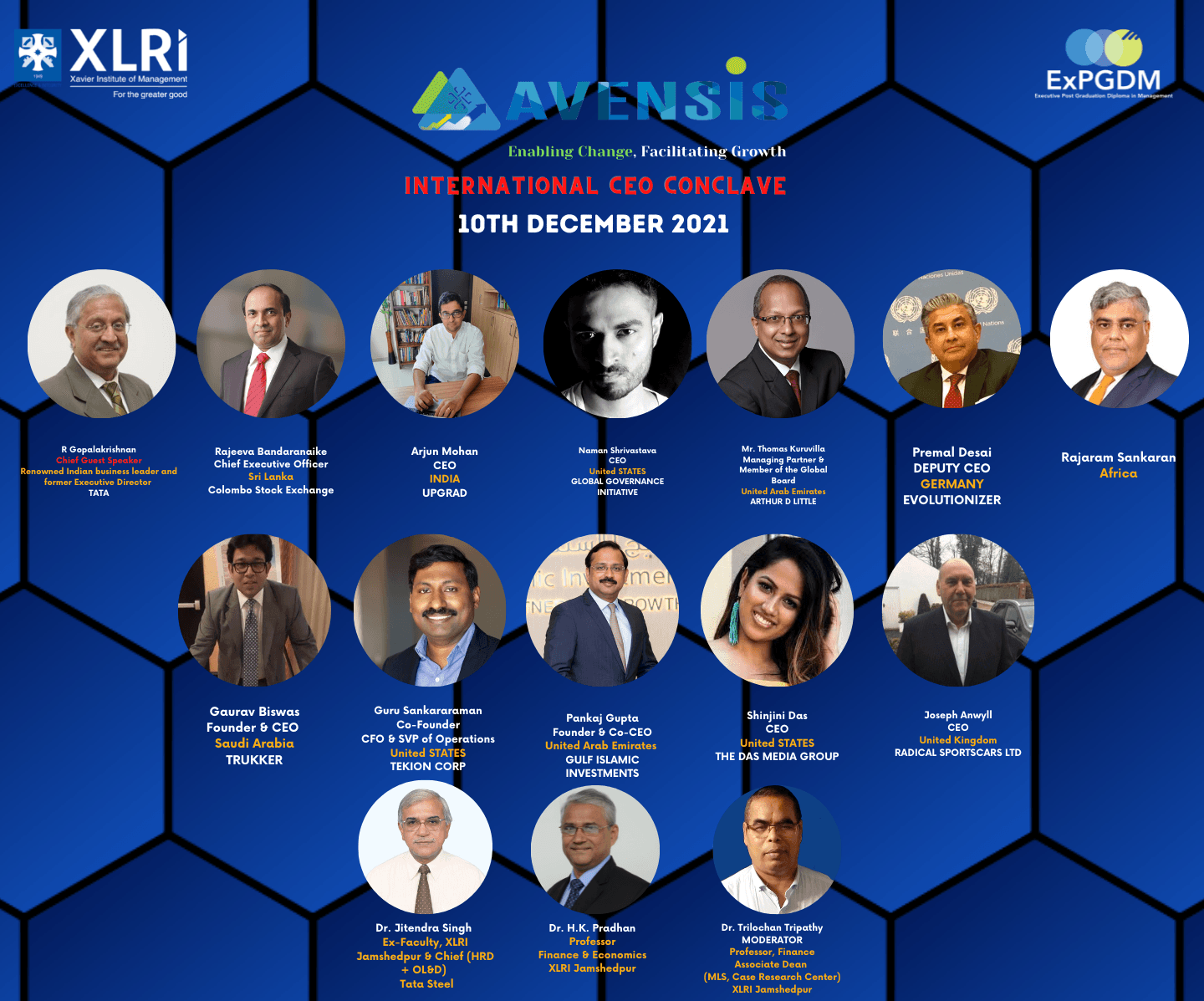
XLRI's PGDM (GM) Class of 2021-22's Conclave Committee successfully organized and conducted its maiden International CEO Conclave - AVENSIS on December 10, 2021. The day started with the inaugural address by Dr. H K Pradhan, Professor, Finance & Economics at XLRI Jamshedpur, where he shed light on the changing scenarios of jobs and skills. It was followed by a welcome speech from Dr. Jitendra Singh, Ex-Faculty at XLRI Jamshedpur & Chief (HRD + OL&D) at Tata Steel, who talked about the changing landscapes in the business world over the decades and how the business leaders are responsible for leading the organizations through the changes.
Mr. R Gopalakrishnan, CEO, The Mindworks and Former Executive Director at Tata Sons, was the Chief Guest of the Conclave, who talked about the importance of Adaptability Quotient, shedding light on qualities that leaders should develop viz., understanding the opinions of people who are affected by the decisions, stimulating debate, and encouraging discussion, establishing priorities, and demanding discipline in the ranks, and developing empathy.
The opening session was followed by a keynote session on "Stock Exchanges and Economic Development - Overview of the Modern-Day Stock Exchange" by Mr. Rajeeva Bandaranaike, CEO, Colombo Stock Exchange from Sri Lanka. He presented key highlights on opportunities and challenges for the capital markets, pension reforms, low-Interest rates, low valuations, strong corporate earnings growth, and various ways to attract foreign investments.
A panel discussion titled "Expert Opinion" by Mr. Pankaj Gupta, Founder & Co-CEO, Gulf Islamic Investments, UAE & Mr. Gaurav Biswas, Founder and CEO Trukker, Saudi Arabia, deeply dived into their journeys from a nascent idea to start-up. Dr. Trilochan Tripathy, Professor, Finance, Associate Dean (MLS, Case Research Center), moderated this discussion at XLRI Jamshedpur. Mr. Rajaram Sankaran, CEO, Pharma Giant, African landscape, and based out of Uganda, was the next keynote speaker for the pre-lunch session. He talked about demystifying Africa and pointed out that the continent is going through rapid urbanization with high potential opportunities for new businesses.
The post-lunch phase of the event started with a keynote session on "Transformation Journeys: The Reasons - Why, and The Art of How!" by Mr. Thomas Kuruvilla, Managing Partner and Member of the Global Board Arthur D 'Little, UAE. He talked about automation and digitalization at the workplace and how technologies like IoT and blockchains will transform how we live and interact with each other. He explained it through the example of technological transformations and adoptions happening in Dubai city.
The next session was titled "Adrenaline Rush with Radical," and Mr. Joseph Anwyll, CEO of Radical Sportscars, United Kingdom, was the keynote speaker for this session. He talked about his love for sports cars and following his love and passion for building Radical Sportscars. It was followed by another intriguing session on "EdTech that Empowers People - Optimizing the Online Learning Experience" delivered by Mr. Arjun Mohan, CEO, UpGrad, India.
In the next leg of the Conclave, Mr. Premal Desai, Dy CEO, Evolutionizer, Germany, shared his thoughts on the "Revolution of Strategy Development" and the increasing applications of blockchains in strategy designing. It was followed by a highly energetic session by Ms. Shinjini Das, CEO, The Das Media Group, Atlanta, USA. Ms. Shinjini shared her incredible journey from her engineering days at Georgia Institute of Technology to starting The Das Media Group and how she helps people make their lives happy by connecting to them personally and making them a "Go-Getter." She delivered her perspective on converting followers into dollars by making the audience relate to your story and understand you and connecting to the audience on a personal level.
It was followed by a rich interactive session by Mr. Naman Srivastava, CEO, Global Governance Initiative, based out of Boston, Massachusetts, USA, where he answered questions on soft and hard skills and the importance of an MBA. The day's final session was an interactive discussion with Mr. Guru Sankararaman, Co-founder, CFO, and SVP of Operations at Tekion, California, USA. He talked about his time at Tesla, his interactions with Mr. Elon Musk, and his guiding principles behind starting Tekion, where he is endeavoring to build the world's best business applications on the cloud for the automotive retail industry.
The day concluded with a Vote of Thanks delivered by the Student Placement Committee.
AVENSIS - International CEO Conclave was organized by the student-driven Conclave Committee in collaboration with the PGDM (GM) Placement Office. The student conclave committee consisted of Charulata Jerai, Manish Budhwar, Noopur Shrivastava, Piyush Bawane, Sarika Singh Katiyar, and Shrish Gopal Upadhyay.
Gallery
No images to display
Avensis International CEO conclave
XLRI PGDM (GM) has successfully completed its International CEO Conclave- AVENSIS on 17th and 18th February 2023
XLRI’s Auracia Club inaugurated its International CEO Conclave – Avensis on 17th February 2023 with dignitaries from the Administrative Services sharing their significant and thought-provoking experiences on the topic “Leadership at Grassroot Level”.
The event started with the lighting of the lamp that was done by Father George, Father Donald, Prof Sanjay Patro, Prof. A Kanagaraj, Mr Rajni Ranjan and the dignitaries.
It started with the Keynote Address by Mr. Rahul Purwar (IAS), Secretary- Higher & Technical Education- Jharkhand, where he shared his views on Sustainability as a means of long term that is a right blend of approaching all three aspects – People, Purpose, and Planet. He shared his views that Sustainability is beyond just solutions. We need to introspect what that situation that demands and tailor an approach that can be a beginning to long-lasting transformation. He emphasised the necessity to design changes in such a way that those changes enable an organisation to solve the present problems and prepare the organisation for any changes that might come in the future. He further went on to highlight the importance of designing process changes in an organisation which are sustainable. The sustainability of any process can be ensured only if the three segments of stakeholders- Customers, Employees and Community are kept in mind while designing any process changes.
He concluded his speech by saying that private and government entities contribute equally to society. Both, government, and private entities should focus on the well-being of the customers, employees, and community to add value to the society.
It was followed by Fireside Chat –on Topic “Leadership at Grassroot Level”. The Panel comprised of: -
- Mr. Rahul Purwar (IAS) - Secretary- Higher & Technical Education- Jharkhand
- Mr. Arava Rajkamal (IAS) - DC- Seraikela
- Mr. Ananya Mittal (IAS) - DC - West Singhbhum
- Mr. Prabhat Kumar (IPS) - SSP East Singhbhum
- Mr. Piyush Sinha (IAS) - SDM Dhalbhum Jamshedpur East Singhbhum
Mr. Arava Rajkamal shared his views on his journey as an officer stating that his love for economics. He shared economics is to policy is what physics is to engineer so even for business for that matter is exactly what physics is to engineer so it gives you a perspective to analyse every event. He emphasized that intuition development was the best part of learning, aiding in quantifying human and firm behaviour. Regarding his experience, "Each posting is a challenging experience, and you learn something new." He also emphasized that the likelihood of failure decreases when multiple layers of leadership exist.
Mr. Prabhat Kumar shared with how inculcating leadership is a challenging process, he emphasized on we are living in a world where resources are limited and the people, we are dealing with might have limited capabilities. Mr. Prabhat talks about how these challenges can be overcome by bringing uniformity in the process and aligning the team to changing technologies. He also talked about importance of bridging the gap between public and police force. Mr. Prabhat talked about how technology is helping to bridge that gap and requested the future leaders from XLRI to work on solving the problems of rural India. He further added that going forward they were to launch a chatbot that would help people retrieve their lost phones and save them the difficulty to go to the police station to file a report. The number is 9006123444. He shared that they have taken this unique number so nobody has to go to a police station after this for restoring mobile loss. They have also used the Word “JOHAR” in their chatbot to make it more relatable for the common people. This will directly go to their technical centre in his office, & you will be contacted I the phone is found.
Mr. Ananya Mittal shared that the importance of some time to self-reflect and think upon things that you usually miss out on in this busy lifestyle. He focused on the importance of work life balance and how he chooses to keep his best focus at work during work hours to balance his personal life as well. He shared that his experience. Regarding his experience on the move to Jharkhand he shared his views as “Today most of the business acumen being used to solve are for urban centric problems. Being from Delhi and coming to Jharkhand has given the new prospective. Taking the example of mid-day meal program in the rural India, there is numerous opportunities for new business ideas, numerous avenues to solve. There is a huge scale that is already present. Its up to ideation and the utilization that can add more value. “He also shares with examples from his experience that “In leadership, appreciation is very important. It inspires to take on more challenges.”
Mr. Piyush Sinha shared his experience as a freshly appointed IAS officer and how he focused to get into Administrative Services and his various experiences amongst his seniors and peers. He shared how a leader can differ from his attributes and there is no one way that an issue can be resolved but one needs to look for solutions. Leadership is all about getting the work done. The crux of this attitude is professionalism and the way to get the work done should be in logical way. In govt setup the role is not limited, and the scope is not defined. In this environment a great leader is who can take the major number of things to the culmination. Everyone is a born leader and depending upon their attributes they become leader in some specific sphere. It is a natural ability and continuous thorough process were some of his thoughts.
The inaugural day event was concluded with a Vote of Thanks on the 1st Day.
The second day of Avensis conclave started with moderation by Ms. Dilpreet Kaur, Student, PGDM (GM), XLRI Jamshedpur on the topic: Conflict management in the cross-functional project teams in an international corporate environment.
Panellists: comprised of
- Mr. Vikas Kaushik, CEO, Tech Ahead, USA
- Mr. Gaurav Verma, COO, US India Strategic Partnership Forum (USISPF), USA
- Mr. Sunil Rana, CEO, Vyzrd, Australia
- Dr. Harish Pillai, CEO, Metro Pacific Health (MPH), Philippines
- Mr. Palash Nandy, CEO, Legrand Australia, and New Zealand
Mr. Palash Nandy shared that “If conflict is good or bad depends on the context. Conflict on ideas for sure is a good thing. When we take a step back, we understand that most of the conflicts happen for one, as plenty of times the team lost track of the bigger goal and get lost in the smaller goals. It becomes like the elephant in the room. Everybody is looking at the same thing but from different perspective and not ready to step back and look at the bigger picture.
Dr Harish Pillai emphasized how understanding a location's history, followed by its culture, is a vital life lesson. Due to linguistic limitations, various teams' responses to the same message would vary. Also, the concept of empathic leadership is crucial. He highlighted how the team-based approach is superior to the silo-based approach and that having a clear vision is required for the team to collaborate. Based on his prior experiences, he focused on how tailoring your management style to the country in which you are operating is the key to successful management.
Mr Gaurav Verma elaborated that there are better things to do than cost compromise in a world driven by profit and performance. A leader should ensure that team members feel engaged and know what is expected of them. It all boils down to leadership as when to step in the conflicts, open communication with the team members and being a decision maker.
Mr. Vikas Kaushik mentioned the challenge he faced during Covid in India as Indian culture was unprepared for Work from Home. This was the fertile ground for the conflict, but they found a way out with collaboration among the team. To sum up, he mentioned that being Emotional Intelligent is the trait we need for better conflict management. Listening raises you to become an Emotional Intelligent Leader.
Mr. Sunil Rana talked about how conflict resolution is built on two main pillars. Communication is essential in conflict resolution. Individual cultural values also play an important role. Corporate culture and values are critical components of conflict resolution. The complexity is changing, and clarity around the end goal is required.
Respect is one of the organizational values that influence team collaboration. Today, constructive criticism, rather than conflict resolution, is required.
Next was followed by a Keynote Address by Mr. Rajesh Sethuraman, CEO / President Director Indonesia & Business Head ASEAN, Godrej Consumer Products, Indonesia on the topic: How do the strategies of business transformation in organization evolve across different cultures. Mr. Rajesh Sethuraman shared that “Discussion from a personal experience on organizational change, he mentions “It is important to let go of a successful past and embrace adaptation to change and idea which comes from a different culture and makes the change relevant for the culture in context. These are reflections of the quality of thinking, clarity of vision, and conviction behind the change to land a change
The impact of change is consistent, but culturally we should take those relevant translations. But more importantly, we must bring in the ability to convince that the change needs a cultural shift because more often, big organizations managed centrally have a potential tendency to think what is shared by the centre is applicable everywhere.
Following this, was a Keynote Address by Mr. Sandeep Uppal, CEO, HSBC, Philippines on the topic: Stakeholder management across divided geographies. Mr. Sandeep Uppal began by discussing his 33-year career, of which nearly 30 years were spent at HSBC Bank. He had 25 years of experience in managing stakeholders. He explains, "Most individuals believe stakeholder management is primarily concerned with politics. Stakeholder management is crucial for both the corporate and individual sides. It is your network that benefits the business and team. Certainly, from a personal standpoint, it is extremely fulfilling. Never attempt to control Stakeholders; instead, you must weave a purpose. There must be a reciprocal interaction or exchange of values. There is a fine line separating perception from reality. Perception is reality unless contradicted by evidence."
This insightful keynote speaker was followed by Expert Opinion (Panel Discussion) Moderated by Mr. Shantanu, Student, PGDM (GM), XLRI Jamshedpur on the topic: Epiphany of Business Transformations: People, Purpose, or Profits. Panellists comprised of:
- Dr. Ramamurthy Venkatesh, CEO, NETS International, UAE
- Mr. Rajesh Kumar, CEO and MD, OPV Pharma Vietnam, RVK Myanmar
- Mr. Suman Bose, Board Member and Investor, Multiple Companies, Singapore
- Mr. Pankaj Aggarwal, CEO and Founder, Tag Hive Inc, South Korea
- Ms. Suchi Shinde, Senior Partner, and Co-Founder, Right sourcing GmbH, Germany
Mr. Pankaj Aggarwal says “The three elements of profit, purpose, and people are inseparable, they go hand in hand. But we need to have the definitions correct”. He goes on to define, “Purpose is why are we doing what we are doing. But the problem is people stop at the first why. We must go to multiple levels of the why. People are not the people in the company, rather are the people outside the company, not just the end user but the society. Profit is what makes financial sense for the company. We should also add the planet to the dimension. And each of these elements would reinforce each other, in the short or long term.”
Ms. Suchi discussed how business transformation is taking place everywhere around us. There are three key drivers of business transformation, with new technology driving automation and providing opportunities for new skill development being the most significant. The second factor is geopolitical upheavals that significantly impact our lives, such as the impact of war on supply chains last year. Moreover, employment from home has gained prominence during Covid. The third factor is the environmental impact. We are now highly knowledgeable about this topic. The focus is on green products, green projects, and sustainable development.
Mr Rajesh shared his inputs on Purpose, being very meaningful. Organisations should shift their meaning of the Triple Bottom Line, People, planet, and profit, to more on Purpose, Planet, and People. Profit would undoubtedly follow the same. He elaborated on API makers' significant challenges that they are facing in compliance. We need to have the right action in place to develop the business. Any market development for the new initiatives needs to be supported with proper incentives, bureaucratic setup, and environmental norms to meet international standards.
Dr. Ramamurthy mentioned the business transformation revolving around People, process, and purpose, but this only gives a myopic view. Change is permanent, inevitable, and acceptable, but how fast and how much is the question business leaders should focus upon. Every industry is different, the countries also drive the demands, and the transformations are planned according to it. According to Dr. Ramamurthy, the business's core purpose should be to keep people happy.
Mr. Suman Bose mentions “A business exists because there is an opportunity. It is the opportunity-seeking behaviour of organizations that is why the organizations exist. It’s the need to hang the picture is why we have the nail and the hammer. Then comes the ethical parameter, and that is where the purpose comes into play. He also mentions that the biggest challenge for organizations to crack is the people. The profit is a by-product”.
This was followed by a Keynote Address by Mr. Girish Sharma, CEO, Colgate Tolaram, Nigeria on the topic:Transforming Business- Change is the only constant.Mr. Girish Sharma started the discussion by sharing his learnings with the XLRI student community and asked them to make the most of their time at XLRI.
He shared insights from his journey with Indomie in Nigeria and how it has maintained its leadership position in Nigeria. One of the most important learnings he shared with the students was that companies must understand the culture of the market if it wants to sell their products. He said, “You must satisfy your customers by solving their problems. This can happen only after understanding your customers.”
The next in line was a keynote Address by Mr. Anshuman Anand, CEO R&B (KSA) Vice President, Apparel Group, Dubai on the topic: Transforming Business & People. Mr. Anshuman Anand started the discussion by highlighting that business transformation is a necessity and not just a buzzword. He highlighted various challenges such as Lack of Commitment from Company Leadership, Internal Resistance from the company and lack of clear communication at various leadership levels. These factors hinder successful business transformation in many companies. He also emphasised the need for a company’s strategy and culture to be in sync with each other for the successful business transformation of a company.
In line was another keynote Address by Mr. Suresh Sundararajan, CEO, Olam Ventures & Olam Technology & Business Services, Singapore on the topic: ‘Purpose & Profit’ -Staying Relevant in Changing Times!.
Mr. Suresh started the discussion with how organizations started off and pivoted to businesses which weren’t their core competency. He highlighted the importance of identifying the core competency and having the foresight of bringing innovations that would radically change the dimension of the business. He emphasized on identifying innovations, which irrespective of the size of the business, would help in securing bigger share of market & creating value for the customers.
The last Panel discussion was Moderated by Mr. Sohrab Faraz, Student, PGDM (GM), XLRI Jamshedpur on the topic: Role of workforce in lean startup. The panellists comprised of
- Mr. Rakesh Dighe, CEO, Risk Quotient, UK
- Mr. Mallikarjun Rao, Chief Technology & Information officer, Telefónica Germany
- Mr. Suneet Walia, CEO, Soterius Inc, USA
Mr. Mallikarjun Rao started the discussion with the importance of agility, discipline, and transparency. He further talks about the second important thing culture, which works well when organizations work on democratizing the attributes of one’s decision-making process. He also talks about in the case of lean start-ups; it becomes crucial to stick to an idea and time the decision to take the risk as the start-ups run on limited fuel. However, larger organizations can try multiple ideas at a time considering they have enough shock absorbers.
Mr. Rakesh emphasized that startups give opportunities and exposure to employees that large corporations cannot. He highlighted that an organization should be kind, and approachable and should have a flat structure where one needs to demonstrate kindness to the employees. He suggested the Mantra that all startups should imbibe is to ‘Think, Learn and Innovate’. Startups are expected to be much more flexible and the stride for continuous innovation is what will help them be flexible and resilient. He also highlighted the importance of training new joiners in a faster way so that transition time would be reduced.
Mr. Suneet Walia started the discussion by highlighting the need for the company’s workforce to be aligned in the same direction. He said, “The most critical component of a business transformation is the leadership team and its ability to align the efforts of the entire workforce in the same direction. The workforce, in this case, would include the company’s employees, vendors, distributors, and external consultants.” Mr. Walia stressed the need for innovation since you need to differentiate yourself from your competitors. However, he cautioned against innovating just for the sake of innovation. Innovation should always have a purpose and it should help the customer to solve their problems.
The grand event was concluded with a Vote of Thanks. The event was organized seamlessly under the able guidance of Prof. Kanagaraj Ayyalusamy & Mr. Rajni Ranjan and the entire Avensis Team.
Media Coverage
- https://insidejharkhand.in/jamshedpurxlri-pgdm-gm-has-successfully-completed-international-ceo-conclave-avensis/
- https://rashtrasamvad.com/more-package-is-not-the-standard-of-good-of-any-organization-and-person-rahul-purwar/
- https://www.livehindustan.com/jharkhand/jamshedpur/story-rahul-purwar-will-participate-in-the-ceo-conclave-7783291.html
- https://avenuemail.in/xlri-jamshedpur-hosts-international-ceo-conclave-avensis/
- https://avenuemail.in/solutions-for-customers-problems-top-priority-colgate-tolaram-ceo-at-xlri-conclave/
Gallery
No images to display
Avensis International CEO Conclave
AVENSIS International CEO Conclave Concluded Successfully on 10th December 2021
XLRI's PGDM (GM) Class of 2021-22's Conclave Committee successfully organized and conducted its maiden International CEO Conclave - AVENSIS on December 10, 2021. The day started with the inaugural address by Dr. H K Pradhan, Professor, Finance & Economics at XLRI Jamshedpur, where he shed light on the changing scenarios of jobs and skills. It was followed by a welcome speech from Dr. Jitendra Singh, Ex-Faculty at XLRI Jamshedpur & Chief (HRD + OL&D) at Tata Steel, who talked about the changing landscapes in the business world over the decades and how the business leaders are responsible for leading the organizations through the changes.
Mr. R Gopalakrishnan, CEO, The Mindworks and Former Executive Director at Tata Sons, was the Chief Guest of the Conclave, who talked about the importance of Adaptability Quotient, shedding light on qualities that leaders should develop viz., understanding the opinions of people who are affected by the decisions, stimulating debate, and encouraging discussion, establishing priorities, and demanding discipline in the ranks, and developing empathy.
The opening session was followed by a keynote session on "Stock Exchanges and Economic Development - Overview of the Modern-Day Stock Exchange" by Mr. Rajeeva Bandaranaike, CEO, Colombo Stock Exchange from Sri Lanka. He presented key highlights on opportunities and challenges for the capital markets, pension reforms, low-Interest rates, low valuations, strong corporate earnings growth, and various ways to attract foreign investments.
A panel discussion titled "Expert Opinion" by Mr. Pankaj Gupta, Founder & Co-CEO, Gulf Islamic Investments, UAE & Mr. Gaurav Biswas, Founder and CEO Trukker, Saudi Arabia, deeply dived into their journeys from a nascent idea to start-up. Dr. Trilochan Tripathy, Professor, Finance, Associate Dean (MLS, Case Research Center), moderated this discussion at XLRI Jamshedpur. Mr. Rajaram Sankaran, CEO, Pharma Giant, African landscape, and based out of Uganda, was the next keynote speaker for the pre-lunch session. He talked about demystifying Africa and pointed out that the continent is going through rapid urbanization with high potential opportunities for new businesses.
The post-lunch phase of the event started with a keynote session on "Transformation Journeys: The Reasons - Why, and The Art of How!" by Mr. Thomas Kuruvilla, Managing Partner and Member of the Global Board Arthur D 'Little, UAE. He talked about automation and digitalization at the workplace and how technologies like IoT and blockchains will transform how we live and interact with each other. He explained it through the example of technological transformations and adoptions happening in Dubai city.
The next session was titled "Adrenaline Rush with Radical," and Mr. Joseph Anwyll, CEO of Radical Sportscars, United Kingdom, was the keynote speaker for this session. He talked about his love for sports cars and following his love and passion for building Radical Sportscars. It was followed by another intriguing session on "EdTech that Empowers People - Optimizing the Online Learning Experience" delivered by Mr. Arjun Mohan, CEO, UpGrad, India.
In the next leg of the Conclave, Mr. Premal Desai, Dy CEO, Evolutionizer, Germany, shared his thoughts on the "Revolution of Strategy Development" and the increasing applications of blockchains in strategy designing. It was followed by a highly energetic session by Ms. Shinjini Das, CEO, The Das Media Group, Atlanta, USA. Ms. Shinjini shared her incredible journey from her engineering days at Georgia Institute of Technology to starting The Das Media Group and how she helps people make their lives happy by connecting to them personally and making them a "Go-Getter." She delivered her perspective on converting followers into dollars by making the audience relate to your story and understand you and connecting to the audience on a personal level.
It was followed by a rich interactive session by Mr. Naman Srivastava, CEO, Global Governance Initiative, based out of Boston, Massachusetts, USA, where he answered questions on soft and hard skills and the importance of an MBA. The day's final session was an interactive discussion with Mr. Guru Sankararaman, Co-founder, CFO, and SVP of Operations at Tekion, California, USA. He talked about his time at Tesla, his interactions with Mr. Elon Musk, and his guiding principles behind starting Tekion, where he is endeavoring to build the world's best business applications on the cloud for the automotive retail industry.
The day concluded with a Vote of Thanks delivered by the Student Placement Committee.
AVENSIS - International CEO Conclave was organized by the student-driven Conclave Committee in collaboration with the PGDM (GM) Placement Office. The student conclave committee consisted of Charulata Jerai, Manish Budhwar, Noopur Shrivastava, Piyush Bawane, Sarika Singh Katiyar, and Shrish Gopal Upadhyay.
Gallery
No images to display